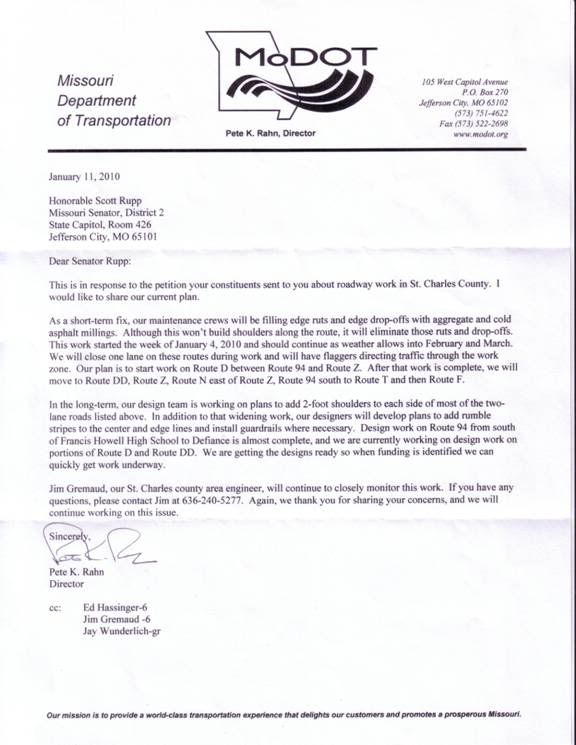
Weather-Related Disclaimer: missives from legislators concerning road conditions, although timely and important, should be considered snapspots in time. For the most recent travel information, please consult MoDOT's Web site at http://www.modot.org/.

Disclaimer:
except when the post starts "MO Expat", all content published on Missives from Missouri is written and supplied by the noted legislator. Said missives will not necessarily reflect the views of Kyle Hill, the operator of Missives from Missouri, and as such the operator does not assume responsibility for its content. More information
Share this missive:
Showing posts with label 95-SB586. Show all posts

06 July 2010

Goodman: Family Matters Newsletter

Senate Bill 617 Senate Bill 586 House Bill 2081 Senate Bill 793 House Bill 1692 House Bill 1692 House Bill 1802 Senate Joint Resolution 31 House Joint Resolution 62 Sen. Goodman's Newsletter
Sen. Goodman's Newsletter

Kraus: Standing on Principle

You may have seen my name in the news recently when the Speaker of the House removed me from the Job Creation and Economic Development Committee.  I wanted to take this opportunity to explain.

Standing on principle, I refused to guarantee House leadership my vote on a bill to be brought before the committee before the bill was even heard or discussed.  My firm stand caused me to be removed from the committee ten minutes before it began. The vote in question was the committee vote on the Manufacturing Jobs Act, which proposes to allow companies up to $10 million per year in tax incentives.

Work in committee is to hash out the specifics of a bill, hear both sides, and decide if a bill is good for the taxpayers or not.  I was in Jefferson City, ready to listen, but I was told to vote 'yes' regardless of testimony and discussion and without knowing the final language of the bill. That is too much like business-as-usual in Washington, D.C.  I simply couldn't guarantee to vote yes or no.

On June 30, the newspaper in Jefferson City, the News-Tribune, reported on the story and had this to say about my removal on its editorial page, "A lawmaker elected to represent constituents doesn't deserve to be benched for pledging to listen to reasoned debate and cast an informed vote on an issue.  Those are the types of abuses that give politics a bad name."

In good conscience, I can't just be a 'yes' man for House leadership and forego thinking about what is best for my constituents.

According to the Speaker's office, other members were removed from a committee because they were not present at the Capitol to vote.  For more information, you can click on this link to an article by the Associated Press:  Kraus Removed from Special Session Committee.

I-470/US50 Half-Diamond Interchange Ready for Public Use

Traffic operations at Interstate-470 and US 50 in Lee's Summit will soon flow easier and smoother now that the Missouri Department of Transportation (MoDOT) completed the Split-Diamond Interchange in this busy area of Lee's Summit. The Half-Diamond Interchanges at Pryor Road and Blue Parkway were finished last year, and now traffic will be able to access each end with the use of the new connector roads that opened Monday, June 28.

The connectors officially complete this $45 million project that was designed to improve traffic operations for the more than 130,000 vehicles that use the junction of I-470 and Routes US 50/MO350. Spanning U.S. 50 and MO 350, these roads join the two half-diamond interchanges, creating what is commonly referred to as a Split-Diamond Interchange.  Motorists traveling on I-470 will now have access to each area of the completed interchange, allowing for more efficient travel and traffic congestion relief throughout the area.

Gov. Nixon Signs Bills into Law

Governor Nixon has signed the following bills into law.  For more detailed information about each bill, please click on the bill number and you will be taken to the state website where the bill and other pertinent information is posted.  In my next newsletter, I'll have information on other bill signings.

HB 1965 - Repeals various expired provisions of law, changes the laws regarding certain state publications, and establishes a joint committee on Missouri's future and a committee on accountability

HB 1643 - Changes the laws regarding certain documents recorded with the county recorder of deeds

HB 2070 - Changes the laws regarding joint central fire and emergency dispatching services taxes

HB 1868 - Changes the laws regarding keys to the Capitol dome, state agencies, and MO HealthNet claims and establishes the Joint Committee on the Reduction and Reorganization of Programs within State Government

SB 649 -Requires the Governor to issue an annual proclamation designating March 12th as "Girl Scout Day"

HB 1662 - Authorizes the State Veterinarian to restrict the movement of animals or birds under investigation for the presence or suspected presence of a toxin

SB 808 - Modifies compensation and continuing education requirements for public administrators

SB 1007 - Amends various requirements for public assistance programs administered by the state

SB 842 - Modifies provisions relating to public assistance programs administered by the state

SB 739 - Modifies the provisions governing fire department employee residency requirements

HB 2081 - Specifies that a pregnant woman may use deadly force if she reasonably believes that deadly force is necessary to protect her unborn child against death, serious physical injury, or any forcible felony

HB 1898 -Establishes the Women's Heart Health Program to provide heart disease risk screenings to certain uninsured and underinsured women

SB 586 - Regulates sexually oriented businesses

25 June 2010

Goodman: Adult Business Bill Receives Governor's Signature

SB 586 & 617 Enforces Time, Place, and Manner Restrictions on Sexually Oriented Businesses


JEFFERSON CITY — After several years of working to pass a bill that strengthens regulations on adult businesses, Sen. Jack Goodman, R-Mt. Vernon, and Sen. Matt Bartle, R-Lee's Summit, announce today that the governor has signed Senate Bill 586 & 617 into law.

Senate Bill 586 & 617 combats the negative secondary effects of sexually oriented businesses in Missouri by imposing several meaningful time, place and manner restrictions. After Aug 28, 2010, the legislation will prohibit a person from establishing a sexually oriented business within 1,000 feet of a pre-existing school, house of worship, state-licensed day care, public library, public park, residence or other sexually oriented business. It also bars a person who has been convicted of or imprisoned for certain crimes within the last eight years from establishing an adult business.

In addition, the bill prohibits nude performances and restricts semi-nude activity within sexually oriented businesses. It also prohibits adult establishments from operating between the hours of midnight and 6 a.m., and bars anyone younger than 18 from being on the premises at any time.

"This is a hard-fought victory for family values," Sen. Goodman said. "We have crafted an effective, yet well-measured and responsible bill that will regulate sexually oriented businesses within the defined parameters of the U.S. Constitution."

Senator Goodman's SB 617 was combined with Sen. Bartle's SB 586 during the Senate's committee approval process.

"This issue has been a top priority of mine for many years," Sen. Bartle said. "It's a tremendous relief to me that my colleagues recognized the importance of this issue and fought to get a bill passed before regular session ended. One need only take a short trip on any of Missouri's major highways to see that the proliferation of smut shops is out of control. There's no question that regulations need to be put in place so we can protect our communities from decreased property values and an environment ripe for crime."

Senate Leader Charlie Shields, R-St. Joseph, said Missouri communities will benefit from the bill.

"Adult businesses in Missouri have been allowed to open and operate with minimal oversight for far too long," Sen. Shields said. "The actions of the governor today will ensure that our state continues to be a family-friendly place to live and visit."

08 June 2010

Gatschenberger: Missouri's Budget, End of Session Legislative Summary and Town Hall Invitation

Town Hall Report

As promised… the following is a summary of the budget information covered at our last Town Hall Meeting.   Although the material may be a bit technical, I believe it is worth your time to understand our State's Budget.  If you have questions, please don't hesitate to contact my office.

I. FY 2011 MISSOURI STATE BUDGET SUMMARY (May, 2010)

State Fiscal Year 2011 (July 1, 2010 – June 30, 2011)
Total Missouri State Operating Budget$23,274, 922,486
State General Revenue7,260,461,973
Federal Budget Stabilization (unrestricted)572,388,526
Federal Budget Stabilization (education)287,037,940
Federal Funds7,035,061,286
Other Funds

(Highway & Road Funds; Lottery & Gaming Proceeds;

Conservation, Parks Soil & Water; Outstanding Schools Trust Fund, etc)
8,119,972,761
That $7.3 billion Net State General Revenue is derived from:
  • $4.8 billion or 66.4% from Individual Income Tax
  • $1.8 billion or 24.4% from Sales and Use Tax
  • $0.4 billion or 4.9% from Corporate Income Tax
  • $0.3 billion or 4.3% from Other Taxes
Largest Expenditures of Net State General Revenue:
  • $2.8 billion or 38.9% for Elementary & Secondary Education
  • $2.3 billion or 31.9% for Social Services, Health & Senior Services and Mental Health
  • $0.9 billion or 12.5% for Higher Education

II. Missouri State Budget History

Normal/Average Net State General Revenue (GR) growth is + 3 to 4% more than the previous year's collections.  Over the last 10 years, it has been as low as (-) 3.2% in FY 2002 and as high as +9.2% in FY 2006

In FY 2009, last year, net tax collections dropped by what was at that time, was "the largest percentage drop" of minus (-) 6.9% below the previous year's revenues.  This drop resulted in actual net GR collections for FY 2009 of $7.4 billion, which is equal to the amount the state collected in FY 2006.

Missouri's Constitution requires that the Governor use line-item vetoes and/or withholding of funds from state agencies and programs when actual revenue collections drop below budgeted collections.  In FY 2009, the Governor withheld and reduced spending authorizations by $272.0 million.

The FY 2010 budget that we are currently getting ready to end on June 30 was built on estimated revenue growth of positive + 1.0%.  However, our national and state economies, driven by record unemployment of nearly 10%, have resulted in revisions that net GR collections could drop by more  than minus (–) 9.0%!  As a result of this shortfall, the Governor has vetoed or withheld more than $900.0 million of GR expenditures by state agencies and programs this year.

The American Recovery & Reinvestment Act of 2009 has provided one-time Federal Budget Stabilization and targeted one-time Federal Stimulus Funds to the states.

Federal Budget Stabilization Funds (FBS) are provided over a 27-month period from Oct 2008 thru Dec 2010.  These one-time funds total approx'ly $2.4 billion that have been used to shore up the state budgets for (last year) FY 2009 and (this year) FY 2010.

Federal Stimulus Funds totaling another $2.6 billion are available for one-time "targeted and competitive" grants for state and local programs such as: job training, law enforcement, energy projects, unemployment benefits and broadband.

III. Special Circumstances for the FY 2010 Missouri State Budget

The original revenue estimate made 18 months previous for the FY 2011 budget was an optimistic + 3.6%.  However, as a result of the drastic reductions in state revenue in FY 2009 and 2010, the more recent revised estimate is a modest +2.2% growth on a much lower base of $6.7 billion of net GR in FY 2010.

On January 20 of this year, the Governor recommended a budget for FY 2011 that assumed the + 3.6% growth.  His spending proposals also included use of an additional $300.0 million of one-time "Extended" Federal Budget Stabilization Funds above and beyond the 27-month period of the 2009 American Recovery & Reinvestment Act.   These additional one-time Extended Federal Budget Stabilization funds had been proposed in federal legislation, but have not yet been approved by Congress.

In March, the Governor asked the House and Senate Budget Committees to cut the budget he proposed for FY 2011 by $500.0 million.  The Governor's request to the General Assembly was to cut $200.0 million due to the FY 2011 revised general revenue estimate from + 3.6 to + 2.2% and his acknowledgement that the state may not receive the $300.0 million of Extended Federal Budget Stabilization Funds that he had included in his budget.  The House and the Senate worked together to make the very difficult and unpopular decisions to cut $484.0 million of GR from the FY 2011 budget that was proposed by the Governor in January.

In May, the Governor announced that he plans to cut $350.0 million more from the FY 2011 budget approved by the Legislature because some proposed budget-related legislation did not pass, the administration does not agree with some assumptions in the appropriations and monthly collections continue to fall below estimates.

IV. Challenges to the FY 2012 Missouri State Budget

The one-time Federal Budget Stabilization Funds totaling $860.0 million (see page 1 – the $572 million and $287 million) will be gone after the state FY 2011 budget.

Even if we get the Extended $300.0 million of FBS, we still have somewhere between $560 to $860 million MORE TO CUT from the base of the FY 2012 budget before we can even consider the increases that will be requested for the School Foundation Formula, Higher Education, Medicaid , Corrections, Public Safety, etc.

V. Highlights of the FY 2011 Missouri State Budget

  • Flat funding for School Foundation Formula ($3.4 billion from all Funds)
  • $15.0 million reduction to Foundation Transportation ($153.0 million)
  • 5.2% or $50.0 million reduction in direct aid to Higher Education Institutions and Community Colleges ($911.0 million)
  • $13.0 million cut in funds for Access Missouri need-based Scholarships ($83.0 million)
  • $20.0 million reduction to state employee benefits
  • $6.0 million reduction on Biodiesel subsidies ($13.4 million)
  • $6.0 million reduction to Tourism ($13.9 million)
  • $7.5 million additional for Corrections inmate health & mental health care ($136.6 million)
  • $5.6 million additional for caseload growth in the Dept of Mental Health
  • $16.5 million additional for Medicaid Home & Community Services in the Dept of Health & Senior Services
  • $30.6 additional for Medicaid caseload growth in the Dept of Social Services

Please be my guest!

What:  Town Hall Meeting
When:  Thursday, June 24th – 7:00 pm
Where:  Wentzville City Hall – 310 W Pearce Blvd
Why:  Information on what the University of Missouri Extension Office can do for you as an individual… or as a small business. Scott Killpack from the University of Missouri Extension Office in St. Charles County will explain what is available and how you can take advantage of their services.  For example… did you know they can help you with your yard problems?  Your health & nutrition questions?  Your small business ideas?  Your needs as a dislocated worker?  Your family financial maze?


Also, James Gremaud from the Missouri Department of Transportation will be on hand to give you an update of MoDot projects in the 13th District and get your thoughts on Truck Lanes.

You won't want to miss this very important information session… so please mark your calendars now!

More than 70 people attended my last Town Hall Meeting in Wentzville

For questions on the content of this meeting you may contact my Capitol office at (573) 751-3572 or e-mail me at Chuck{dot}Gatschenberger{at}house{dot}mo{dot}gov

04 June 2010

Rupp: Honoring Those Who Served

This Memorial Day I attended the beautiful ceremony held at the Lake St. Louis Veterans Memorial Park. It was awe inspiring to see so many people turn out to honor those who have served our country by paying the ultimate price. This kind of event reminds me of the great sacrifices we have made to form this great country of ours, and that it is a tremendous honor and privilege to be an elected leader from the great state of Missouri.

Our surviving heroes of World War I and II, the Korean War, and even the Vietnam War are getting fewer with each passing year. At the same time, we must also remember our heroes in Desert Storm, Operation Enduring Freedom, and Iraqi Freedom. Many of our state's best men and women continue to defend our freedom in lands all across the world. We must never lose sight of the sacrifices our soldiers make when they put their lives on the line for our freedom. There is no way we can ever repay them for this gift, and the least we can do is treat that sacrifice with the dignity and gratitude that it deserves – and not just on Memorial Day.

This past legislative session, I was proud to vote for House Bill 1524, a large veteran's bill that I believe sets a few things right when it comes to how we treat the defenders of our country. House Bill 1524 requires that service-disabled veteran run businesses in Missouri get a point preference when it comes to state agency bids.

The bill also requires the state to form a Missouri Youth Challenge Academy for at-risk high school age youth. The residential military-based academy will provide work experience and training in life skills, citizenship, life-coping and academic skills, and other personal development skills. It is my firm belief that the discipline and life skills taught in this academy will turn many lives around for the better.

But perhaps most importantly, HB 1524 allows our soldiers currently overseas the option to fill out an absentee ballot and exercise their right to vote. In today's age of electronic information, there is no longer an excuse for not allowing our brave men and women the opportunity to participate in the democracy they work so hard to defend. It's the right thing to do and the right time to do it, and it is good to know that this brave group of Missourians can have a say in their own future with the right to vote.

Thank you to all of the brave soldiers who have served and who continued to serve, and God bless this great country of ours.

Senator Rupp Announces Partnership to Widen West St. Charles County Roads


On June 1, 2010, I announced that a project is already underway to meet citizen demands for safer and wider roads in West St. Charles County.

In a partnership between the State of Missouri, St. Charles County, and the local quarry operations, the Missouri Department of Transportation (MoDOT) recently began engineering work on Highways D, DD, and 94 in West St. Charles County.

I've been working with MoDOT to allocate funds for this project since 2006, and those efforts have paid off thanks to the hard work of many people. There was a tremendous effort from a citizen's group, the county, and many more. Together, we made it happen.

The funding that has been secured will mean 15 miles of paved, three-foot shoulders on each side of the road, making dangerous stretches of Highways D, DD, and 94 safer for travelers. Construction is set to begin in the spring of 2011 with completion by the end of that year.

DWI Bill Signed into Law


Now that the General Assembly is nearly three weeks into the interim, the focus has shifted to one of the final steps in the legislative process: the governor's signature.

Last week (5/25), the General Assembly convened for a technical session to officially send most of the passed 2010 bills to the governor's desk for his signature. The governor has until July 14 to either sign or veto each bill; if he doesn't lend his signature to any piece of legislation by the deadline, it automatically becomes law.

Every bill the governor vetoes is sent back to the sponsoring chamber with his objections. The governor's vetoes, if any, will be considered by the Legislature when it reconvenes for veto session in mid-September. If lawmakers decide to try to override a veto, it will be put to a vote. To overturn a governor's veto, a two-thirds majority vote in both chambers is required.

Most of the passed bills that are signed by the governor become law on Aug. 28, though some contain "emergency clauses" that had to be approved separately from the legislation. Any bill or provision attached to an emergency clause may take effect immediately upon receiving the governor's signature (or at another specified date).

This week, the governor signed into law House Bill 1695, a bill that is intended to strengthen Missouri's DWI laws and crack down on repeat offenders. The legislation makes several changes to the state's laws regarding intoxication-related traffic offenses, including:
  • Allowing any circuit court to establish a special DWI court to handle such cases when the driver has a blood alcohol content (BAC) of at least .15, has pled guilty to or been found guilty of one or more intoxication-related traffic offenses, or has two or more previous alcohol-related enforcement contacts.
  • Prohibiting any person who operated a motor vehicle with a BAC of .15 or more from being granted a suspended sentence.
  • Specifying that for a first offense, unless a person participates and successfully completes the requirements of a DWI court, a person who operated a motor vehicle with a BAC between .15 and .20 will be imprisoned for at least 48 hours, and a person who operated a motor vehicle with a BAC of .20 or more will be imprisoned for at least five days.
  • Increasing the minimum amount of jail time from five days to 10 days for a prior offender and from 10 days to 30 days for a persistent offender to be eligible for parole or probation—unless, as a condition, the person performs a certain amount of community service or participates in a court-ordered treatment program.
  • Specifying that any DWI case will not be carried out in municipal court if the defendant has been convicted, found guilty, or pled guilty to two or more previous intoxication-related traffic offenses or had two or more previous alcohol-related enforcement contacts.
  • Making the reporting of DWI cases more uniform and centralized by requiring the State Highway Patrol, beginning Jan. 1, 2011, to maintain regular accountability reports of alcohol-related arrests, charges, and dispositions based on the data submitted by law enforcement and prosecutors.
Now that it has received the governor's signature, the provisions of HB 1695 will be enacted into law on Aug. 28, 2010.

Other Top Legislative Priorities Await Governor's Signature


The other key priorities that legislators identified at the beginning of the session still await the governor's signature, including bills that institute ethics reform, provide insurance coverage for autism, strengthen regulations for adult businesses, expand informed consent requirements for abortion, and make changes to two of the state's major college scholarship programs. Some of the main provisions of these bills include:

Ethics Reform

Senate Bill 844 , sponsored by Senate President Pro Tem Charlie Shields (R-St. Joseph), allows the Missouri Ethics Commission to investigate ethics violations without an outside complaint being filed; requires contributions of more than $500 to incumbent officials and their challengers during legislative session be electronically reported within 48 hours; and limits the transferring of contributions among most committees.

Autism Insurance Coverage

House Bill 1311, which is my language from SB 618, requires health carriers that issue or renew health benefit plans on or after Jan. 1, 2011, to provide coverage for the diagnosis and treatment of autism spectrum disorders; prohibits health carriers from refusing to cover an individual or dependent solely because the individual is diagnosed with autism; and provides coverage for applied behavior analysis, a common treatment method for autism, up to $40,000 annually through age 18.

Adult Business Regulations

Senate Bill 586, sponsored by Sen. Matt Bartle (R-Lee's Summit), prohibits a person from establishing a sexually oriented business within 1,000 feet of certain entities; prohibits nude performances and restricts semi-nude activity within sexually oriented businesses; prohibits adult establishments from operating between the hours of midnight and 6 a.m., and bans the use, sale and consumption of alcohol on the premises.

Expanded Informed Consent for Abortion

Senate Bill 793, sponsored by Sen. Rob Mayer (R-Dexter), requires, at least 24 hours prior to an abortion being performed, that a woman be presented with various printed materials detailing the risks of an abortion and the physiological characteristics of an unborn baby; given an opportunity to view an active ultrasound and hear the heartbeat; and provided information regarding the possibility of the abortion causing pain to the unborn baby past 22 weeks.

The bill also requires the physician to discuss the medical assistance and counseling resources available, advise the woman of the father's liability for child support, and provide information about the Alternatives to Abortion Program.

College Scholarships

Senate Bill 733, sponsored by Sen. David Pearce (R-Warrensburg), changes and equalizes Access Missouri scholarship amounts for public and private universities; protects Bright Flight scholarship eligibility for students who serve in the military, and expands Bright Flight scholarship eligibility to those who have received a GED, or completed a homeschooling program of study, secondary coursework through Missouri's Virtual Public School, or any other academic program that satisfies the compulsory attendance law.

All of the above bills will become law Aug. 28, 2010, upon receiving the governor's signature with the exception of SB 733, which contains an emergency clause that applies to certain provisions.

As always, if you have any questions about this week's column or any other matter involving state government, please do not hesitate to contact me. You can reach my office by phone at (866) 271-2844.

26 May 2010

Gatschenberger: Town Hall Report, Constitutionality of Adult Business Regulations, School Safety Measure Passes

Town Hall Report

Last week I held a Town Hall Meeting at the Lake St. Louis City Hall. Larry Schepker, Director of House Appropriations and Mike Price, Budget Analyst III, presented the 2011 State Budget and answered questions regarding funding cuts. They also explained why the 2012 budget will be even more of a challenge for us to balance during the next legislative session due to an $850,000,000 decrease in Federal funding. A detail of his report will be in my next Capitol Report.


Representative Brian Nieves, R – District 98… Candidate for Missouri Senate District 26… explained the State Sovereignty Legislation we passed and the resulting vote that will be put before you on the August ballot giving you the opportunity to exempt yourself and your business from the new Federal Health Care requirements.


Representative Brian Nieves speaks to Town Hall Attendees


Please be my guest!

What: Town Hall Meeting
When: June 24th – 7:00 pm
Where: Wentzville City Hall – 310 W Pearce Blvd
Why:
Information on what the University of Missouri Extension Office can do for you as an individual… or as a small business. Scott Killpack from the University of Missouri Extension Office in St. Charles County will explain what is available and how you can take advantage of their services. For example… did you know they can help you with your yard problems? Your health & nutrition questions? Your small business ideas? Your needs as a dislocated worker? Your family financial maze?

Also, James Gremaud from the Missouri Department of Transportation will be on hand to give you an update of MoDot projects in the 13th District and get your thoughts on Truck Lanes.

You won’t want to miss this very important information session… so please mark your calendars now!

More than 70 people attended my last Town Hall Meeting in Wentzville

For questions on the content of this meeting you may contact my Capitol office at (573) 751-3572 or e-mail me at Chuck{dot}Gatschenberger{at}house{dot}mo{dot}gov

Legislative Update

I heard from many of you regarding the Sexually Oriented Business Regulation Legislation in SB’s 586 and 617… so I am sharing a summary that details the intent and provisions of HCS SS SCS SBs 586 & 617 as follows:

Key Elements of the Legislation…

  • Restricts placement of sexually oriented businesses
    Cannot be within 1000 feet of a preexisting school, house of worship, state-licensed daycare, public library, public park, residence, or other sexually oriented business.
  • Restricts ownership
    No person shall establish a sexually oriented business if a person with an influential interest in such business has been convicted of, or released from confinement, for certain crimes within the last eight years.
  • Limits nudity and contact with patrons
    Employee must remain on stage at least six feet from the patrons and at least eighteen inches from the floor
  • Requires an unobstructed view of each area that patron’s are permitted
    The worst offenses take place behind closed doors.
  • Allows 180 days to come into compliance
  • Restricts hours and alcohol
    No sexually oriented business shall be open between the hours of midnight and 6:00 a.m.
    Prohibits alcohol sales, use, or consumption on premises of sexually oriented business.
  • Establishes the standard that violations are committed “knowingly or recklessly”
  • Penalty of violations
    A misdemeanor punishable by a fine not to exceed $500 or imprisonment not to exceed 90 days.
    Any business repeatedly operated in violation of this act shall constitute a public nuisance and shall be subject to civil abatement proceedings.

Constitutionality of this Legislation:

The Supreme Court has ruled that regulations of sexually oriented businesses are constitutional so long as they are not aimed at preventing speech ("unrelated to the suppression of free expression"), but rather are directed at stopping the "negative secondary effects" associated with "adult" establishments. Thus, if your intent is to protect neighborhoods keep crime down and preserve property values, and if you still allow the pornographic speech to occur subject to certain regulations, there is no constitutional violation.

Court Cases
8th Circuit Court – 10 cases:
http://www.communitydefense.org/wordpress/2009/08/12/8th-circuit-authorities-for-various-sob-ordinance-requirements/#more-1046

There are at least 170 sexually-oriented businesses in Missouri (55 cities, 31 counties)

School Safety Measure Passes

A wide ranging school safety bill that I cosponsored (HB 1543) passed the General Assembly on the last day of the session and includes the following:
  • Expanding the reporting of violent acts to include all teachers at the student’s school and other employees who need to know.
  • Specifying that a suspended student who is not allowed on school property without permission is also prohibited from attending school events occurring elsewhere.
  • Requiring a notice of reportable offenses to be attached to an offending student’s record and transcript.
  • Allowing school districts to require a school uniform or restrict student dress.
  • Exempting unqualified employees who refuse to administer medication or medical services from disciplinary action.
  • Exempting qualified employees from civil liability for administering medication or medical services, in good faith and according to standard practices.
  • Requiring any spanking to take place in front of a witness who is a school district employee.
  • Specifying that use of reasonable force by school employees to protect people or property is not considered child abuse.
The bill also requires districts to change the definition of “bullying” to include cyber-bullying. Also, contractors or subcontractor working on construction projects at public and charter schools must conduct random drug and alcohol testing. St. Louis City schools will be allowed to use a hearing officer for employee termination hearings as long as they are under control of a Special Administrative Board.

Schools given funding flexibility

School districts will have some spending flexibility during the next few years, because legislators aged to relax some stat e requirements during times of financial difficulty. The changes are included in the same bill I co-sponsored (HB 1543).

School districts will be exuded from required spending 0n professional development in fiscal years 21011, 2012, 2013 if the foundation formula is not funded at the level that is needed to meet the phase-in percentages for the new formula. They will also be excluded for the same years if transportation funding is not enough to reimburse 75 percent of costs.

School districts must send at least 1 percent of their state money on professional development. Under this proposal, when the state does not meet its obligation for funding the foundation formula or transportation, the state would not require schools to send money on professional development. Schools would also be relieved of their required fund placement and expenditure requirements.

The flexibility extends into the Missouri School Improvement Program as well. If the state fails to meet the same financial commitments, the school districts will not be penalized for failure to meet the resource standards that are part of MSIP.

Ed Departments to Stay Separate

“A proposal to combine state education departments provided too many questions and not enough answers”, said committee member Chuck Gatschenberger.

As a result, voters will not decide on this issue in a constitutional referendum this November. The Department of Elementary and Secondary Education will not merge with the Department of Higher Education.

SJR 44 and 45 (Senator Charlie Shields) were intended to streamline education, from early childhood to post secondary. The committee became bogged down discussing the proper size of the board and whether board members should be appointed at large from geographical areas, or represent certain segments of education.

Committee members also became concerned about the actual duties and powers a new board would have. Many of these would not be defended in the constitution, but in state statuettes that would have to be developed upon voter approval. The merger would not have made dramatic changes to K-12 education, but committee members were uneasy about its potential impact to higher education. As a result, the proposal did not move forward in the committee.

Representative Gayle Kingery announced he intends to send a letter to the speaker of the house requesting the Joint Committee on Education discuss this issue, and make a report available before the next legislative session.

STAY IN TOUCH

As always, please let me know your thoughts about these or other matters of concern by calling my office at: (573) 751-3572 or by emailing me at chuck{dot}gatschenberger{at}house{dot}mo{dot}gov

FUN FACTS

Listen to a free Chorus… courtesy of Mother Nature and the Gray Tree frogs this month… also bird song at daybreak is at its peak this month.

Stake out a den and watch the parade... young beavers, woodchucks and groundhogs… even coyote pups… emerge from their dens and take a look around.

20 May 2010

Nance: Monsignor Retires, Session Recap


Pictured above, Lawson resident Bob Lammers' brother, Monsignor Donald W. Lammers led the House in prayer for many years before retiring last week.


Below is a report by House Communications on the last week of session.

2010 Legislative Session Concludes


With the bang of the Speaker's gavel, the 2nd Regular Session of the 95th General Assembly came to a close at 6 p.m. Friday. Members of the Missouri House engaged in the traditional paper-toss, clearing their desks of documents accumulated during a session that resulted in the passage of 74 House bills and 32 Senate bills.

After the papers settled, legislative leaders met with the press to discuss some of the priority legislation approved by the House and Senate. Bills now on their way to the governor's desk to be signed into law address issues such as ethics reform, insurance coverage for autism, strengthened DWI penalties, new regulations for sexually oriented businesses and additional informed consents requirements for abortion.

Ethics Reform Package Receives Final Approval


On the final day of the legislative session, the Missouri House gave final approval to an ethics reform package designed to increase transparency and accountability in the political process. The House approved SB 844, handled in the House by Rep. Tim Jones, R-Eureka, by a vote of 153-5.

"This is one of the most aggressive ethics packages in this country and it will make a difference. It will make government more transparent. It will make campaign finance more transparent. It will make us more accountable. And it will make the citizens of our districts more proud of the work we do up here in a fine and transparent fashion," said Jones.

One provision of the bill would address the issue of political money laundering by restricting committee-to-committee transfers of campaign donations. SB 844 would limit the number of political committees and make it a crime to transfer committee funds with the intent to conceal the source of the original funds. Rep. Tim Flook, R-Liberty called the provision one of the most important in the bill.

"With this bill, we're eliminating as many as, I've heard by one estimate, almost 700 political committees that were used to transfer donations, that were used to launder money in some cases, hiding donations in other cases," Flook said. "Those committees going away is a major, major change in our state and I think that puts Missouri on the cutting edge of ideas for ethics reform. The public deserves to know who you receive support from."

The bill also gives the additional authority to the Missouri Ethics Commission to launch investigations. Under current law, the commission can act only after receiving a complaint. SB 844 would allow the commission to launch an investigation after a unanimous vote of all six commission members. The bill would also create the crime of obstructing an ethics investigation.

In addition, the bill would require that campaign contributions made during a legislative session in excess of $500 be reported within 48 hours. The bill would also make it a crime for an elected official to offer a job to a lawmaker in exchange for votes. SB 844 would also create new crimes for lobbyists who do not properly report how much they spend on meals and gifts for state officials.

While the legislation received strong bipartisan support, some members said the bill represents only the first step of many toward true ethics reform.

"I think that we have begun the conversation about ethics reform. I look forward to being back next year and in the interim to make sure we can improve upon this, but I think it would be a huge mistake to call it comprehensive," said Rep. Jason Kander, D-Kansas City. "On the other hand, I think that we have done something to improve the law. I am proud of that and I look forward to immediately after taking this vote, getting to work with everybody else on accomplishing true, comprehensive ethics reform."

The bill now moves to the governor's desk to be signed into law.

General Assembly Approves Bill to Enact Stiffer Penalties for Drunken Drivers


The Missouri General Assembly passed legislation Thursday that would create stronger penalties for DWI offenders. HB 1695, 1742 & 1674 is sponsored by Rep. Bryan Stevenson, R-Webb City, who said the bill contains a wide range of provisions dealing with drunken driving offenses.

"This bill overall is a good balance between increased treatment for first time offenders that find themselves in an unusual situation ….and increased stiffer penalties for individuals with a chronic drinking problem who have a real addiction issue," Stevenson said. "It's going to cost very little because we are going to divert some individuals out of the prison system, and the number of people not sitting in prison will be in treatment and on continuous alcohol monitoring," Rep. Stevenson said.

The bill would require drivers with blood-alcohol levels of at least 0.15 percent to spend 48 hours in jail, and those with at least 0.2 percent to spend at least five days in jail, unless they complete the requirements of a DWI court or docket. In addition, the bill would allow any circuit court to set up a DWI docket for repeat offenders or those whose blood-alcohol content exceeded 0.15 percent. Several Missouri courts already offer DWI Courts, which allow repeat DWI offenders to avoid jail time while receiving treatment for alcohol abuse.

The bill would also require state courts to handle any DWI case involving a defendant with at least two alcohol-related contacts with authorities, require police and prosecutors to adopt policies for reporting information on DWI offenses to a central databank, increase the minimum jail time for previous DWI offenders from five to 10 days and increase the minimum jail time for a persistent offender to 30 days.

Rep. John Burnett, D-Kansas City, was satisfied with the final version of the bill. "I think this will be the first DWI bill I've voted for since I've been here," Burnett said to Stevenson. "I think that you have struck a great balance with this bill. I've been a great critic of increasing penalties and thinking that penalties alone will deter drunk driving and make our highways safe. This bill does increase penalties, but it also focuses on the treatment aspects and I wanted to thank you publicly for that."

However, Rep. Jeff Roorda, D-Barnhart had mixed feelings about the legislation, which had several provisions removed when it was approved by the Senate.  "If mixed drinks were as watered down as this bill, we'd have a lot less drunks on the street," said Roorda, a former police officer. "This is a little bittersweet because we've fallen a little short of our wide-eyed imaginings, but let's cut to the positive. There is expansion to DWI courts. There are controls over these third time convictions of DWIs in the courts, so there is some good stuff in this bill."

The House approved the bill by a vote of 152-0. The bill now moves to the governor's desk to be signed into law.

General Assembly Approves Legislation to Provide Coverage to Children with Autism Spectrum Disorders


State-regulated group insurance policies would have to provide coverage for children with autism spectrum disorders under legislation approved by the Missouri General Assembly Wednesday. Rep. Dwight Scharnhorst, R-St. Louis, sponsors HB 1311 & 1341, which was passed through the House with a vote of 144-16 and through the Senate by a vote of 27-6

HB 1311 & 1341 would require group insurance policies to provide coverage for applied behavioral analysis services (ABA) for autistic children age 18 and younger. The coverage would have an annual cap of $40,000 and would be adjusted each year for inflation.

The bill went through several compromises in conferences with the Senate, including the age limit and caps on coverage, which were changed from the initial bills in both chambers.

"(The bill) is what I would consider a comprehensive bill that the legislature, the governor and all of us here in Missouri should be very proud that we have stepped forward to address this issue." Scharnhorst said.

Rep. Jason Grill, D-Kansas City, who sponsored HB 1341, expressed his appreciation on the passage of the bill. "This is a monumental day for Missourians. We are going to get a vote that we wanted on this bill," said Grill. "Many families that are listening right now, this is a big day for them. I have learned so much about this horrible illness, and hopefully in the future we can find ways to fix this through this therapy."

Some legislators worried an insurance mandate would place an undue burden on small businesses. Scharnhorst said he typically opposes mandates but felt the issue of autism merits a different approach. "I was a small business owner for many years…and it was never my intent to create a negative impact on employers.  If this mandate increased employers rates by more than 2.5 percent, it would allow them to opt out of the coverage," said Scharnhorst. Scharnhorst has previously cited studies showing an autism mandate would raise premiums by less than one percent.

The bill would also establish a state Behavior Analyst Advisory Board under the State Committee of Psychologists within the Division of Professional Registration. The new board would be charged with establishing and overseeing licensure and registration requirements for behavior analysts and assistant behavior analysts who provide therapies for children with autism spectrum disorders.

The provisions of HB 1311 & 1341 would apply primarily to Missourians receiving health insurance from small- and medium-sized employers. Missourians with individual insurance policies would not be mandated to obtain a policy with autism coverage, but would have the option to do so. Large employers who insure themselves fall under federal regulation.

The bill now awaits the governor's signature.

General Assembly Sends Bill Banning Sale of Synthetic Marijuana Drug "K2"


The General Assembly passed legislation Thursday that would add a type of synthetic marijuana to the state's list of controlled substances. Rep. Ward Franz, R-West Plains, sponsors HB 1472 to prohibit the substance, commonly known as K2, in the state of Missouri.

"I think it's important to get it off the shelves to protect our children," Franz said.

The synthetic cannabinoids contained in K2 are very closely related to tetrahydrocannabinol, or THC, the chemical in marijuana. However, because the chemicals in K2 are slightly different than THC, they are not covered by existing drug laws. Currently, Missourians of any age can buy K2 packaged as "potpourri" at many stores that sell tobacco products.

HB 1472 would add the synthetic cannabinoids used in K2 to the Schedule I list of controlled substances. Schedule I drugs include substances such as heroin and marijuana. Under the bill, possession of 35 grams or more of K2 would be a felony offense. Possession of lesser amounts would be a misdemeanor.

House members also considered adopting emergency clause on the bill, which would make the legislation into law immediately upon the governor's signature.

"This applies to getting this off the street quickly," Rep. Franz said. "We felt that we better not wait until the end of August to take a chance on how this could affect somebody's life."

Rep. Jake Zimmerman, D-Olivette, opposed the emergency clause. "I think it's a bad, bad idea to declare new crimes and put emergency clauses on them," Zimmerman said. "As much as I support the bill, I think it's appropriate that we give the law-abiding public of our state an opportunity to know what will be illegal in advance of it becoming illegal."

The House voted to defeat the emergency clause, but passed HB 1472 by a vote of 140-7. The legislation now goes to the governor's desk to be signed into law.

Missouri General Assembly Approves Legislation to Strengthen Informed Consent Requirements


The Missouri House gave final approval Friday to legislation that would strengthen the state's informed consent requirements to obtain an abortion. The House passed the SB 793, handled by Speaker Pro Tem Bryan Pratt, R-Blue Springs, by a vote of 114-39.

The bill would expand current law, which requires that a woman seeking an abortion be told of the physical and psychological risks of the procedure 24 hours prior to the abortion being performed. SB 793 would require that a woman seeking an abortion be given the opportunity to view an ultrasound image and listen to the heartbeat of the fetus. The bill would also require the consultation be done in person instead of over the phone. In addition, the legislation requires that women receive a description of the "anatomical and physiological characteristics of the unborn child. It would also require abortion providers to supply a brochure produced by the state that proclaims: "The life of each human being begins at conception. Abortion will terminate the life of a separate, unique, living human being."

Pratt said the bill is meant to provide additional information to a woman seeking an abortion with the intent of persuading her to change her mind about undergoing the procedure. "With this bill, I think we can go in and make clear and make sure that if an abortion is done in the state of Missouri, that a woman will give proper informed consent," said Pratt. "If given all the medically accurate information, it's my belief that more women will choose not to have an abortion."

Rep. Beth Low, D-Kansas City, opposed the bill and challenged supporters of the legislation to propose a ban on abortion. "If the members of the pro-life majority were serious about ending abortion, we wouldn't see Senate Bill 793. We'd see a Senate Bill or a House Bill that actually outlawed abortion," said Low. "Instead we see cute little bills like this one every year aimed at the most vulnerable people in an incredibly vulnerable time."

SB 793 would also prohibit insurance coverage for abortions under policies offered through any health insurance exchanges, such as those located in the federal health care legislation. In addition, no health insurance exchange operating within Missouri would be allowed to offer coverage for elective abortions through the purchase of an optional rider.

The bill now moves to the governor's desk.

General Assembly Approves Legislation Regulating Sexually Oriented Businesses


The Missouri House gave final approval Thursday to legislation that would enact new regulations for sexually oriented businesses. The House passed SB 586 and 618, handled by Rep. Ed Emery, R-Lamar, by a vote of 118-28.

The bill would require sexually oriented businesses to be at least 1,000 feet from schools, churches, public parks and daycares, and place restrictions on nudity, hours of operation, alcohol sales and employees' proximity to patrons.

Emery spoke on the "negative secondary effects" of these businesses, which he said can include increased crime rates, decreased property values, a decrease in annual income of businesses in the sexually-oriented business vicinity, increased property insurance rates, negatively altered lifestyles of residents' living habits in the vicinity of a sexually-oriented business and the increase of communicable diseases.

"This sets in place serious, significant protections to try to minimize negative secondary effects on communities," Emery said. "We know that this is a widespread issue, and I believe that this bill will seriously control those, and benefit families in Missouri."

SBs 586 & 617 would bar nude activity and restrict semi-nude activity within sexually oriented businesses. It would also ban the use, sale or consumption of alcohol within such businesses. In addition, the legislation would prohibit adult establishments from operating between the hours of midnight and 6 a.m., and bar anyone younger than 18 from being on the premises at any time.

One provision of the bill says an employee can be charged with a misdemeanor for violating certain portions of the bill. Any business repeatedly in violation of the provision would constitute a public nuisance and would be subject to civil abatement proceedings.

Some representatives were not in favor of this portion of the bill.  "Whether or not we agree on this bill, it's just not right to hold employees responsible or liable for the behavior of their customers," Rep. Mike Colona, D-St. Louis, said. "If your boss doesn't properly train you, under this bill, you are going to be criminally liable, and that's just not fair."

Those in opposition to the bill felt that counties and municipalities should have local control over these businesses. Rep. John Burnett, D-Kansas City, inquired of Rep. Bryan Stevenson, R-Webb City, about the issue.  "I've heard you all say quite loudly that if you are not in favor of this bill, you're in favor of pornography, and it seems to me that the real issue here is that your county won't take local control over this issue. If we are going to impose rules…we should not paint this with such a broad brush.  Local control should be allowed. Local people should make local decisions."

The bill now moves to the governor's desk to be signed into law.

Missouri House Passes Bill Creating Statewide Vote on Health Care


The General Assembly passed HB 1764 Tuesday, a bill that would put the issue of federally-funded health care on the ballot for Missourians in August.

Rep. John Diehl, R-Town and Country, sponsors the bill, which originally dealt only with the dissolution of domestic health care insurance companies. However, provisions were added to prohibit persons, employers, or health care providers from being compelled to participate in any health care system. Originally, the health care provision was proposed as a constitutional amendment, but the Senate opted instead to present the issue as a state-wide referendum. This way, the legislation will bypass Gov. Nixon's desk and go straight to the voters to decide on August 3rd.

Diehl said his constituents strongly oppose federal health care. "The residents of this state overwhelmingly reject what you and I have begun calling this Obamination of a bill, which is the federal health insurance bill," Diehl said in conversation with Rep. Tim Jones, R-Eureka, on the House floor. "It's just something I think is on everybody's mind, and they want the ability and the tools to be able to fight back on this."

Rep. Jones agreed, and hoped the referendum would allow citizens express their feelings about the federal legislation. "We're at the end of a long and arduous road, and this will give the people of Missouri the final say on this matter," Jones said. "The politicians here in this body are simply providing the vehicle."

Rep. John Burnett, D-Kansas City, objected to the fact that the health care issue would be paired with the dissolution of insurance companies on the ballot. "I don't question the Senators that have this sense of humor," Burnett said. "But, the joke is that they've taken a bill that is a very, very, very dense bill about the liquidation of domestic insurance companies, how we finalize business and insurance companies, and tied that to a political attack on our national health care system."

House Minority Leader Rep. Paul LeVota, D-Independence, opposed the bill. "This is a heck of a lot better than trying to change our constitution, because that would have been just a complete disaster," Rep. LeVota said. "This clearly is just simply an election year stunt."

The House approved HB 1764 by a vote of 108-47. The issue now goes to the voters for approval on August 3rd.

House Sends Access Missouri Bill to Governor Nixon's Desk


State legislators finished work on SB 733 Wednesday, which would make significant changes to state-funded scholarships for higher education. The legislation would affect both the Access Missouri and Bright Flight scholarship programs.

Rep. Gayle Kingery, R-Poplar Bluff, handled the bill in the House. On the floor, he mentioned portions of the House's version of the bill that the Senate opted to leave out. One of these was the proposal to lower the GPA requirement for the Access Missouri scholarship from 2.5 to 2.0 for recipients' first two years of college.

"We didn't agree with that, but that was one of those things," Kingery said. "We took that part out to preserve the rest of the scholarship bill."

Rep. Joe Aull, D-Marshall, spoke in support of lowering the GPA. "I believe in high academic standards as much as anybody," Aull said. "But, I know that the Access scholarship is a need-based scholarship. A lot of freshman really struggle that first year in college, it's a culture shock adjustment for them, and they've got to get that grade point average up to 2.5. … Somebody could go in right now and have a 2.49, which is pretty darn close to 2.5, and they're going to lose their scholarship. This could be a low-income student, and that's that student's only chance to go to college."

The final bill addresses the discrepancy between scholarship money available to private and public school students through the Access Missouri program. Under current law, students who attend private and public schools are eligible for disparate award amounts. SB 733 would raise the maximum scholarship to $1,300 for community college students and set it at $2,850 for students at either public universities or private institutions, starting in 2014.

SB 733 would also modify the Bright Flight scholarship program. Most significantly, the bill would ensure that students who score in the top 3 percent with their ACT or SAT scores receive Bright Flight merit scholarship awards before those who score in the top fourth or fifth percent. Bright Flight eligibility will expand to the top 5 percent next year under a new state law.

In addition, the bill addresses students who elect to join the armed forces. These students who qualify for a Bright Flight scholarship may defer their award and receive it at a later date, as long as they return to full-time student status within six months of the end of their military service.

Rep. Sue Schoemehl, D-St. Louis, expressed her support for the legislation. "The changes in Bright Flight are very valuable," Rep. Schoemehl said. "So, I would ask the body to continue and to support the military exemptions we had in here."

The bill now goes to the governor to be signed into law.

Legislature Approves Bill to Downsize Government


The Missouri House gave final approval Friday to legislation that would reduce the size of state government and form a committee to study the potential for additional downsizing in the future. The House approved HB 1868, sponsored by Rep. Dwight Scharnhorst, R-St. Louis, by a vote of 124-29.

The bill would transfers the powers and duties of the State Water Patrol to the newly established Division of Water Patrol within the State Highway Patrol. Supporters of the change say it could save the state millions of dollars.

The bill would also establish the Joint Committee on the Reduction and Reorganization of Programs within State Government. The 14-member committee must publish a report by December 31, 2010, with recommendations for reducing, eliminating, or combining state programs and departments.

The bill now moves to the governor's desk to be signed into law.

Legislature Approves Bill to Ensure Prompt Tax Returns


The Missouri House gave final approval Thursday to legislation that would shorten the time the state has to issue tax refunds to Missouri taxpayers. Rep. Stanley Cox, R-Sedalia, sponsors HB 1408 & 1514, which would change the length of time the state can hold onto returns without paying interest from the current 120 days to 90 days.

Under the bill, the state would have 90 days from April 15 to process returns. For individuals who file late returns, the 90-day clock would start when the return is postmarked. Returns that fail to meet the 90-day deadline would be refunded with interest.

The House passed HB 1408 & 1514 by a vote of 147-0. It now moves to the governor's desk to be signed into law.

18 May 2010

Ruestman: Curbing the Effects of Sexually-Oriented Businesses

Session is over!  Of all my eight sessions in the Missouri House, this had to have been the most unusual one.  It was a much calmer, subdued session in large part due to the budget shortfall.  Beyond the budget we were able to pass a few key pieces of legislation that will help to improve the state.  I plan to discuss these issues in the coming weeks, but I want to start with one of the most important problems we were able to address this session.

Locally, we've been faced with the many negative side-effects of the adult industry and the stores that cater to that unsavory market.  Anyone who's traveled I-44 to Springfield knows exactly what kind of businesses I'm referring to.  It is unfortunate that in our conservative corner of the state we are forced to deal with the many bad issues resulting from pornography.

We were able to pass legislation this session to address the worst effects of these places.  Senate Bills 586 and 617, handled by our own Southwest Representative, Ed Emery, are intended to stop the bad behavior and unsavory activities occurring in these businesses.

Some of the tenants of these bills are as follows:
  • Restricts locating a sexually-oriented business to beyond 1000 feet from a preexisting school, house of worship, daycare, public library, public park or private residence.
  • Nudity with contact to patrons is not allowed.  Employees must remain on a stage that is at least six feet from customers and 18 inches off the floor.
  • Sexually-oriented businesses cannot be open between the hours of midnight and 6 a.m.
  • Requires employees to have an unobstructed view of patrons.  Closed doors many times accommodate illegal behavior.
The negative effects of these businesses are numerous, but it is not uncommon to see increased sexual and violent crimes in areas where they are located.  The property values of those living within close proximity usually plummet.

This bill is now headed to the governor to be signed into law.  It is important for our community and the state.  He knows we expect him to sign this bill.  I encourage you to contact his office to let him know you support these bills being signed into law.  His office may be reached by visiting http://governor.mo.gov or by calling 573-751-3222.

If you have problems, questions or wish to express concern over an issue, please do not hesitate to contact me or my Legislator Assistant, Jonathan, at my Capitol office either by phone 573-751-9801 or by e-mail at Marilyn{dot}Ruestman{at}house{dot}mo{dot}gov.

Kraus: End of Session

By the numbers, we ended the 95th General Assembly at 6 p.m. on May 14. We passed 74 House bills and 32 Senate bills in the 2010 session.  By tradition, representatives in the Missouri House engaged in the end-of-session paper-toss, clearing their desks of bills and amendments accumulated during the session.  Overall, I was disappointed that a number of important issues remained unaddressed.

As usually happens, the last week of session saw a number of bills bounce back and forth between the Senate and the House with some being Truly Agreed To and Finally Passed and sent on to the governor's desk for his action.  In this issue, I'm providing a brief overview of some of those bills. In future reports and after it is signed into law, I will provide more information about the final bill.

Legislature Approves Bill to Ensure Prompt Tax Returns


Last year, my office received several complaints from individuals that the state was taking inordinately long to return their tax refunds.  The state currently has 120 days to return a refund to the taxpayer without paying interest.

This year, the Missouri House did something about these complaints, through HB 1408 and 1514, by shortening the wait time to 90 days or the state would be required to pay interest.  The 90-day clock would start on April 15, or if filed late, from date of the postmark of the tax forms.  The House approved the bill by a vote of 147-0.

Sale of Synthetic Marijuana Drug "K2"

The General Assembly passed legislation, HB 1472, that would add a type of synthetic marijuana, commonly known as K2, to the state's list of controlled substances. Under the bill, possession of 35 grams or more of K2 would be a felony offense. Possession of lesser amounts would be a misdemeanor.

The synthetic cannabinoids contained in K2 are very closely related to tetrahydrocannabinol, or THC, the chemical in marijuana. However, because the chemicals in K2 are slightly different than THC, they are not covered by existing drug laws. Currently, Missourians of any age can buy K2, packaged as "potpourri" at many stores that sell tobacco products.  The House approved the bill by a vote of 140-7.

General Assembly Approves Legislation Regulating Sexually Oriented Businesses

The Missouri House gave final approval to legislation that would enact new regulations for sexually oriented businesses. The bill would require these types of businesses to be at least 1,000 feet from schools, churches, public parks and day care facilities, and place restrictions on nudity, hours of operation, alcohol sales and employees' proximity to patrons.

SBs 586 & 617 would bar nude activity and restrict semi-nude activity within sexually oriented businesses. It would also ban the use, sale or consumption of alcohol within such businesses. In addition, the legislation would prohibit adult establishments from operating between the hours of midnight and 6 a.m., and bar anyone younger than 18 from being on the premises at any time.

By passing this bill, the General Assembly hopes to mitigate the negative secondary effects of these businesses, which can include increased crime rates, decreased property values, a decrease in annual income of businesses in the vicinity, increased property insurance rates, negatively altered living habits of nearby residents, and an increase of communicable diseases.  The House approved the bill by a vote of 118-28.

Stiffer Penalties for Drunken Drivers Proposed

Last Thursday, the Missouri General Assembly passed legislation, HB 1695, 1742 & 1674, that would create stronger penalties for DWI offenders.

The bill would require drivers with blood-alcohol levels of at least 0.15 percent to spend 48 hours in jail, and those with at least 0.2 percent to spend at least five days in jail, unless they complete the requirements of a DWI court or docket. In addition, the bill would allow any circuit court to set up a DWI docket for repeat offenders or those whose blood-alcohol content exceeded 0.15 percent. Several Missouri courts already offer DWI Courts, which allow repeat DWI offenders to avoid jail time while receiving treatment for alcohol abuse.

This bill seeks to balance increased treatment for first time offenders with stiffer penalties for repeat offenders who may have chronic and more dangerous drinking problems.  Because it may also divert individuals out of the prison system and into treatment, it isn't expected to increase costs to the states.  The House approved the bill by a vote of 152-0.

Missouri House Passes Bill Creating Statewide Vote on Health Care

The General Assembly passed HB 1764, a bill that would put the issue of federally-funded health care on the ballot for Missourians.

The referendum, if passed by a vote of the people, prohibits persons, employers, or health care providers from being compelled to participate in any recently passed health care system- most notably federal legislation recently passed in the U.S. Congress. Instead of going to the governor for signature, the legislation will go straight to the voters to decide on August 3.

I am 100 percent for this bill.  It is the right thing to do to allow our citizens, by their own vote, to give their opinion on federal mandates and government intrusion in our personal health care decisions.  The bill is Missouri's response to the recent passage of federal health control, and I am very happy that we acted to let Missourians have a voice.

If passed, it would not prohibit citizens from participating in the recently passed federal health care programs if they so wished.  The House approved the bill by a vote of 108-47.

With the ending of the 2010 Legislative Session, the Capitol Report will be issued about twice a month. During this time, if you have an event that you would like me to attend or speak at, please contact my office at 1 (573) 751-1459 or e-mail at will{dot}kraus{at}house{dot}mo{dot}gov.

05 February 2010

Rupp: Senate Gives First-Round Approval to Autism Insurance Bill

Staying consistent with their commitment to make Autism insurance reform a top Senate priority in 2010, Senate Leadership put the Autism Insurance Bill as the FIRST bill on the Senate Calendar for the 2010 session.  Debate began on Tuesday, but was limited due to scheduling of Senate committees, so most of the debate was carried over to yesterday.  I'm happy to report that the bill received first round approval by the Senate yesterday afternoon - and we were able to fight off amendments that would have weakened the bill.  We are one step closer to providing help and relief to Missouri families and children with Autism

You can view the floor debate by logging onto my website at http://www.senate.mo.gov/10info/members/mem02.htm - click the Multimedia tab.  On my website you can also sign up for my weekly newsletter.

And you can also sign up for Autism bill updates at www.MoAutismBill.com.

OTHER BILLS RECEIVING SENATE APPROVAL

The Senate also gave preliminary approval to SB 586, sponsored by Sen. Matt Bartle (R-Lee's Summit). The bill would strengthen regulations for sexually oriented businesses in Missouri, including prohibiting anyone from establishing a sexually oriented business within 1,000 feet of a pre-existing school, house of worship, state-licensed day care, public library, residence, or other sexually oriented business. The bill would also require such establishments to close between the hours of midnight and 6 a.m.; prohibit the sale, use and consumption of alcohol on the premises; and regulate the activities that may take place inside sexually oriented businesses.

Also receiving first-round approval this week was SB 604, sponsored by Sen. Rob Mayer (R-Dexter). The measure would prohibit large users of water resources from excessively disrupting the normal irrigation activities of certain large farms in the Southeast Missouri Regional Water District. If a disruption occurs, the attorney general may seek an injunction.

Both SB 586 and SB 604 need a final Senate vote to move on to the House.

SENATE COMMITTEES

The Senate Governmental Accountability and Fiscal Oversight Committee passed Senate Joint Resolution 25, which I co-sponsored. The measure would, upon approval by voters, prohibit any laws from interfering with Missourians' health care choices.  Hopefully, it will be sent to the Senate floor soon for debate.

Ethics reform continues to move swiftly through the legislative process as Senate Bill 577, sponsored by Senate President Pro Tem Charlie Shields (R-St. Joseph), was passed out of the Senate Rules, Joint Rules, Resolutions and Ethics Committee this week and is now eligible for floor debate. The bill would create the position of an independent investigator within the Ethics Commission, bar certain contributions to incumbent officials during session and expand income reporting requirements to include legislative staff.

Also passed out of committee this week was SB 594, sponsored by Sen. Rita Heard Days (D-St. Louis). The Senate Health, Mental Health, Seniors and Families Committee approved the bill, which would allow adopted individuals age 18 and over to obtain copies of their original birth certificates under certain circumstances.

The committee also voted to send a bill to the Senate floor that would allow drug testing of recipients of Temporary Assistance for Needy Families (TANF) benefits. Senate Bill 607, sponsored by Sen. Bill Stouffer (R-Napton), would require the Department of Social Services to develop a program to test work-eligible TANF applicants or recipients when a case worker believes, based on reasonable suspicion, that a person is using illegal drugs. Similar measures were rolled into SB 607, including SB 602, sponsored by Sen. Jason Crowell (R-Cape Girardeau); SB 615, sponsored by Sen. Jack Goodman (R-Mt. Vernon); and SB 725, sponsored by Sen. Scott T. Rupp (R-Wentzville). Senator Gary Nodler (R-Joplin) is also sponsoring a similar bill, SB 821, which is awaiting a committee hearing.

According to SB 607, if the drug test is positive, the individual would be ineligible for TANF benefits for three years and would also be referred to an approved substance abuse treatment program. Also, if a parent is deemed ineligible for TANF benefits because of illegal drug use, his or her child's eligibility for the benefits would not be affected. Instead, a protective payee would be designated to ensure the child receives the benefits. Senate Bill 607 may now be taken up for debate by the full Senate.

Senate Bill 596, sponsored by Sen. Victor Callahan (D-Independence), was passed by the Senate Progress and Development Committee. The bill would allow the governing bodies of any Missouri city to designate Show-Me Small Business Districts within a city for no longer than 23 years. During the designation period, eligible small businesses within these areas could receive tax-favored status for a term not to exceed 15 years.

In addition to sending measures to the full Senate, committees also continued to hear testimony on legislation this week. For instance, some of the bills receiving a hearing in the Senate Financial and Governmental Organizations and Elections Committee were SB 589, sponsored by Sen. Gary Nodler (R-Joplin), which would bar felons from holding public office; SB 629, sponsored by Sen. Tom Dempsey (R-St. Charles), which would establish the Missouri Healthy Workplace Recognition Program; and SB 673, sponsored by Sen. David Pearce (R-Warrensburg), which would create the Office of Job Development and Training and would modify the reporting requirements for obtaining unemployment benefits.

JUDICIARY STATE OF THE STATE ADDRESS

On Wednesday, Feb. 3, Senators gathered for a joint session with the House of Representatives to hear the chief justice give the annual State of the Judiciary address. Click here for the full text of the speech.

The Missouri Senate reconvenes at 4 p.m. on Monday, Feb. 8. The Second Regular Session of the 95th Missouri General Assembly runs through Friday, May 14, 2010.

As the 2010 legislative session unfolds, I will continue to keep you, my constituents, apprised of all major developments, and I look forward to continuing to serve your needs and priorities in Jefferson City. As always, if you have any questions about this week's column or any other matter involving state government, please do not hesitate to contact me. You can reach my office by phone at (866) 271-2844.

29 January 2010

Rupp: Offering Protection For The Citizens of Missouri

If I had to sum up this week's Senate action with one word, that one word would be protection.

Missouri farmers received some Senate protection this week from the State Tax Commission, which had voted to raise taxes on farm land. By a vote of 30-3, we approved Senate Joint Resolution 32 and 35 that says we disagree with the commission's decision to give new, higher values to agricultural and horticultural property. I agreed to co-sign this bill, because 1) I'm against raising any taxes, and 2) our farmers are dealing with enough issues like rising costs and volatile markets and we don't need burden them with additional worries about how they're going to pay their property taxes.  Our state's farmers have enough on their mind as it is. The House of Representatives will examine the resolution soon, and as a Senate body we have vowed to get it passed in the time allotted for us to deny this unjust and badly-timed recommendation.

I testified on my Senate Bill 725 this week before the Senate Health, Mental Health, Seniors and Families Committee. This bill protects taxpayers by requiring drug screenings for welfare recipients.

Basically, if a case worker suspects that one of their clients is using drugs, this gives that case worker the power to test their client. If there is a positive test, the drug abuser is required to participate in a substance abuse program.  If the individual fails to complete the substance abuse program or after completing the program still continues to test positive in subsequent drug tests the individual will be ineligible for Temporary Assistance for Needy Families (TANF) benefits.

This proposed legislation protects the children of welfare recipients by making sure the kids of those recipients who are caught using drugs still get their benefits. And, most importantly, it will offer help to those who may need protection from themselves.

Finally, we're one step closer to real protection for those individuals affected by autism and their families. My autism insurance reform bill, Senate Bill 618, was unanimously approved by the Senate Small Business, Insurance and Industrial Relations Committee and will soon be considered by the full Senate body.

This legislation prohibits health insurance carriers from denying coverage for this devastating neurological disorder that is affecting more and more Missouri children. It covers treatment plans, and sets boundaries on a maximum benefit in a calendar year. A family shouldn't have to go broke while they try to get their child the help they deserve.

The Senate Judiciary Committee passed SB 586, sponsored by Sen. Matt Bartle (R-Lee's Summit), which would strengthen regulations for sexually oriented businesses in Missouri, including prohibiting anyone from establishing a sexually oriented business within 1,000 feet of a pre-existing school, house of worship, state-licensed day care, public library, residence, or other sexually oriented business. The bill would also require such establishments to close between the hours of midnight and 6 a.m. and prohibit the sale, use and consumption of alcohol on the premises.

COMMITTEE HEARINGS

Committee hearings continued to dominate Senate activity this week as the chamber's major ethics reform bill—an issue touted as one of the Legislature's top priorities for the session—was presented in the Senate Rules, Joint Rules, Resolutions and Ethics Committee. Senate Bill 577, sponsored by Senate President Pro Tem Charlie Shields (R-St. Joseph), would create the position of an independent investigator within the Ethics Commission, bar certain contributions to incumbent officials during session and expand income reporting requirements to include legislative staff.

Also receiving a hearing in the Senate Transportation Committee was a bill that would ban texting while driving in Missouri—for all ages. A law passed last year prohibits drivers 21 years of age and younger from texting while driving. Senator Ryan McKenna (D-Crystal City), who also sponsored last year's provision, is sponsoring this year's SB 701. The measure would apply the text message ban universally so that all drivers, regardless of their age, are prohibited from texting while operating a motor vehicle.

Other hearings held this week included:
  • Senate Bill 583, sponsored by Sen. Norma Champion (R-Springfield), was heard in the Senate Small Business, Insurance and Industry Committee. The measure would entitle consumers with long-term insurance policies and Medicare supplement policies to premium refunds, and restricts certain abusive sales practices with respect to Medicare products.
  • Senate Bill 594, sponsored by Sen. Rita Heard Days (D-St. Louis), was heard in the Senate Health, Mental Health, Seniors and Families Committee. The bill would allow adopted individuals age 18 and over to obtain copies of their original birth certificates under certain circumstances.
  • A quartet of bills relating to drug-testing of Temporary Assistance for Needy Families (TANF) recipients and applicants also received hearings in the health committee this week. The bills are SB 602 (sponsored by Sen. Jason Crowell, R-Cape Girardeau), SB 607 (sponsored by Sen. Stouffer), SB 615 (sponsored by Sen. Jack Goodman, R-Mount Vernon), and SB 725 (sponsored by Sen. Rupp). Watch a video clip of Sen. Stouffer discussing the issue.
  • Senate Concurrent Resolution 36, sponsored by Sen. Eric Schmitt (R-Glendale), urges Congress to pass a balanced budget amendment to the United States Constitution. The resolution was heard in the rules committee along with SCR 37, also sponsored by Sen. Schmitt, which urges the attorney general to investigate the constitutionality of the Nebraska Compromise to federal health care legislation.
  • Senate Joint Resolution 23 was heard in the Senate General Laws Committee. The measure, sponsored by Sen. Luann Ridgeway (R-Smithville), would prohibit a political subdivision from receiving state funding if it provides health insurance to its employees through a public health insurance option plan—upon voter approval.
  • Senate Bill 596, sponsored by Sen. Victor Callahan (D-Independence), was heard in the Senate Progress and Development Committee. The bill would allow the governing bodies of any Missouri city to designate Show-Me Small Business Districts within a city for no longer than 23 years. During the designation period, eligible small businesses within these areas could receive tax-favored status for a term not to exceed 15 years.
  • Senate Joint Resolution 25, sponsored by Sen. Jane Cunningham (R-Chesterfield), was heard in the Senate Governmental Accountability and Fiscal Oversight Committee. Upon approval by voters, the resolution would prohibit any laws from interfering with Missourians' health care choices.
  • Also heard in the same committee was SJR 29, sponsored by Sen. Chuck Purgason (R-Caulfield) and Sen. Ridgeway. The measure, upon voter approval, would replace all state income taxes with a sales and use tax. Watch a video clip of the resolution being presented to committee.

The Senate Appropriations Committee also met this week to begin work on the fiscal year 2011 budget after receiving the governor's recommendations during his State of the State address on Jan. 20. Committee members will continue to meet throughout the weeks to come as they begin to develop their budget plan in conjunction with the House Budget Committee. The bills comprising the FY 2011 budget will eventually be debated, first in the House and then in the Senate (all appropriations bills originate in the House).

Fiscal year 2010 ends June 30, 2010. Fiscal year 2011 begins July 1, 2010, and runs through June 30, 2011. The Legislature must send a final state budget for FY 2011 to the governor by May 7, 2010.

Listen to the Senate Minute's report on the budget.

The Missouri Senate reconvenes at 4 p.m. on Monday, Feb. 1. The Second Regular Session of the 95th Missouri General Assembly runs through Friday, May 14, 2010.

As the 2010 legislative session unfolds, I will continue to keep you, my constituents, apprised of all major developments, and I look forward to continuing to serve your needs and priorities in Jefferson City. As always, if you have any questions about this week's column or any other matter involving state government, please do not hesitate to contact me. You can reach my office by phone at (866) 271-2844.

22 January 2010

Rupp: The Real State of Our State

I had a strange experience during the State of the State speech on this week. It seemed to me that Governor Nixon was taking credit for many of the Republican accomplishments made during prior sessions – accomplishments like tuition caps, education funding, and one of my priorities this session that stalled in the House of Representatives last year, autism reform. I am glad that the governor has joined the Republican pledge to not raise taxes, but I’m a bit confused about how he expects that to happen when he cannot reign in his spending.

The budget he submitted to the Legislature for fiscal year 2011 is not balanced, as state law requires, and this year’s budget isn’t balanced either. This year’s budget is about $200 million short, and frankly, there is a good portion of it based on an additional $300 million in stimulus dollars and millions more on legislation that hasn’t even passed yet. Not only is the governor spending money the state doesn’t have and depleting our reserves, he’s now trying to spend money that doesn’t even exist. How many of the 60,000 unemployed Missourians get to buy groceries on money that may or may not be in their bank accounts? Our state’s citizens can’t balance their checkbooks that way and neither should our state government.

Missouri Republicans in the Senate have a plan to keep the governor’s spending in check. We are focused on making sure our schools are fully funded without tax increases. While Gov. Nixon’s job creation bill did not deliver, we’re working on creating and maintaining jobs through less government intervention and smart tax dollar investment. While we’re at it, we’re going to make sure that our state stays out the federal health care mess, and that we provide our own solution to make health care costs accessible and affordable. As of this writing, our governor has not promised to reject federal health care, like the voters of Massachusetts and so many other state governors already have done.

If all of these Republican goals sound like a daunting task, they are. I am expecting vigorous debate about the validity and efficiency of every level of state government. Our state had some serious belt tightening last year, but we are not out of the woods, and that means we must work harder and scrutinize every single penny. You’re doing it at home, and we’ll do it for your home state. I’m in Jefferson City working for you.

COMMITTEES


This week I presented the Autism Insurance Coverage bill [SB618] to the MO Senate Insurance Committee that I chair. (Bill updates can be found on the website at www.moautismbill.com.) The bill would mandate insurance coverage for families with a child on the spectrum, including ABA therapy among other therapies. We had EXCELLENT testimony from myself, Lauri Unumb, Policy Director of Autism Speaks, Dr. John Montovani, John Huff (the Director of Insurance for Missouri) along with several parents who gave compelling and convincing testimony as to their daily struggles and the need for this legislation.

The insurance industry has changed their tune since last year when they testified against the bill. Don't get me wrong they all lined up to testify against the bill, however they were no longer making claims such as ABA is "experimental", or that it’s an "educational issue". They have all come to the realization that we (thousands across Missouri) are demanding this to happen and understand that it will. Their attempts in the Capitol have been to weaken the bill at every turn.

We have many allies in the Capitol including Sen. Eric Schmitt who is a co-sponsor on the bill. We need to make sure that we are reaching out to the supporters of the bill and saying thank you, while at the same time contacting those who are undecided, unknown or against and asking them to help the thousands of Missouri families that deserve this coverage.

It is my plan to bring this bill up for a vote next Tuesday in my committee. Last year a similar bill passed 7-0 and I hope to get the same result this year. The earliest we could debate this on the floor of the Senate is Feb. 1, so that will give us a full week to reach out to fellow senators.

In other committee action, on Wednesday the Senate Education Committee received an update on Missouri’s application for the federal government’s Race to the Top program during its weekly meeting in the Capitol.

Race to the Top is a newly established, highly competitive $4.3 billion grant program that is challenging states to develop ambitious school-improvement proposals addressing four central areas of education reform. These areas are: developing standards and assessments, supporting instruction through data systems, cultivating great teachers and leaders, and turning around struggling schools.

At the committee hearing, the Missouri Department of Elementary and Secondary Education presented an update on the state’s application, which was officially submitted Tuesday, Jan. 19—the deadline for first-round consideration for federal funding under the program. First-round awards are scheduled to be announced April 2010.

The Senate Rules, Joint Rules, Resolutions and Ethics Committee heard testimony this week on SCR 35 (sponsored by Sen. Bill Stouffer, R-Napton) and SCR 32 (sponsored by Sen. Jason Crowell, R-Cape Girardeau), both of which I co-sponsored. The resolutions ask the Legislature to reject a tax increase on some Missouri landowners. On Dec. 15, 2009, the Missouri State Tax Commission voted to increase land valuations on some grades of farmland in Missouri. If a resolution is not passed by the General Assembly rejecting the changes recommended by the commission within 60 days, the land valuation increases will take effect Jan, 1, 2011. We are working to move the resolutions forward in order to stop this tax increase.

And finally, the Senate Judiciary Committee this week heard testimony on a pair of identical bills that would regulate sexually oriented businesses in Missouri. Senate Bill 586, sponsored by Sen. Matt Bartle (R-Lee’s Summit) and SB 617, sponsored by Sen. Jack Goodman (R-Mt. Vernon) would, among other things, prohibit anyone from establishing a sexually oriented business within 1,000 feet of a pre-existing school, house of worship, state-licensed day care, public library, residence, or other sexually oriented business.

Session of The Missouri Senate reconvenes at 4 p.m. on Monday, Jan. 25. The Second Regular the 95th Missouri General Assembly runs through Friday, May 14, 2010.

MoDOT UPDATE


Below is a letter I received from Pete Rahn, Director of MoDOT, regarding Highway 94, Highways D, DD, F and Z.
MoDOT Letter to Rep. Rupp
As the 2010 legislative session unfolds, I will continue to keep you, my constituents, apprised of all major developments, and I look forward to continuing to serve your needs and priorities in Jefferson City. As always, if you have any questions about this week’s column or any other matter involving state government, please do not hesitate to contact me. You can reach my office by phone at (866) 271-2844.