Weather-Related Disclaimer: missives from legislators concerning road conditions, although timely and important, should be considered snapspots in time. For the most recent travel information, please consult MoDOT's Web site at http://www.modot.org/.

Disclaimer:
except when the post starts "MO Expat", all content published on Missives from Missouri is written and supplied by the noted legislator. Said missives will not necessarily reflect the views of Kyle Hill, the operator of Missives from Missouri, and as such the operator does not assume responsibility for its content. More information
Share this missive:
Showing posts with label 95-SB618. Show all posts

04 June 2010

Rupp: Honoring Those Who Served

This Memorial Day I attended the beautiful ceremony held at the Lake St. Louis Veterans Memorial Park. It was awe inspiring to see so many people turn out to honor those who have served our country by paying the ultimate price. This kind of event reminds me of the great sacrifices we have made to form this great country of ours, and that it is a tremendous honor and privilege to be an elected leader from the great state of Missouri.

Our surviving heroes of World War I and II, the Korean War, and even the Vietnam War are getting fewer with each passing year. At the same time, we must also remember our heroes in Desert Storm, Operation Enduring Freedom, and Iraqi Freedom. Many of our state's best men and women continue to defend our freedom in lands all across the world. We must never lose sight of the sacrifices our soldiers make when they put their lives on the line for our freedom. There is no way we can ever repay them for this gift, and the least we can do is treat that sacrifice with the dignity and gratitude that it deserves – and not just on Memorial Day.

This past legislative session, I was proud to vote for House Bill 1524, a large veteran's bill that I believe sets a few things right when it comes to how we treat the defenders of our country. House Bill 1524 requires that service-disabled veteran run businesses in Missouri get a point preference when it comes to state agency bids.

The bill also requires the state to form a Missouri Youth Challenge Academy for at-risk high school age youth. The residential military-based academy will provide work experience and training in life skills, citizenship, life-coping and academic skills, and other personal development skills. It is my firm belief that the discipline and life skills taught in this academy will turn many lives around for the better.

But perhaps most importantly, HB 1524 allows our soldiers currently overseas the option to fill out an absentee ballot and exercise their right to vote. In today's age of electronic information, there is no longer an excuse for not allowing our brave men and women the opportunity to participate in the democracy they work so hard to defend. It's the right thing to do and the right time to do it, and it is good to know that this brave group of Missourians can have a say in their own future with the right to vote.

Thank you to all of the brave soldiers who have served and who continued to serve, and God bless this great country of ours.

Senator Rupp Announces Partnership to Widen West St. Charles County Roads


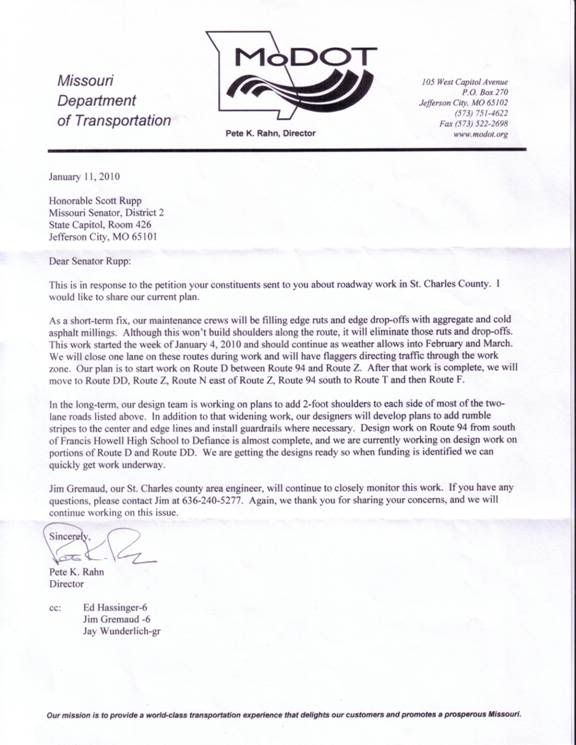
On June 1, 2010, I announced that a project is already underway to meet citizen demands for safer and wider roads in West St. Charles County.

In a partnership between the State of Missouri, St. Charles County, and the local quarry operations, the Missouri Department of Transportation (MoDOT) recently began engineering work on Highways D, DD, and 94 in West St. Charles County.

I've been working with MoDOT to allocate funds for this project since 2006, and those efforts have paid off thanks to the hard work of many people. There was a tremendous effort from a citizen's group, the county, and many more. Together, we made it happen.

The funding that has been secured will mean 15 miles of paved, three-foot shoulders on each side of the road, making dangerous stretches of Highways D, DD, and 94 safer for travelers. Construction is set to begin in the spring of 2011 with completion by the end of that year.

DWI Bill Signed into Law


Now that the General Assembly is nearly three weeks into the interim, the focus has shifted to one of the final steps in the legislative process: the governor's signature.

Last week (5/25), the General Assembly convened for a technical session to officially send most of the passed 2010 bills to the governor's desk for his signature. The governor has until July 14 to either sign or veto each bill; if he doesn't lend his signature to any piece of legislation by the deadline, it automatically becomes law.

Every bill the governor vetoes is sent back to the sponsoring chamber with his objections. The governor's vetoes, if any, will be considered by the Legislature when it reconvenes for veto session in mid-September. If lawmakers decide to try to override a veto, it will be put to a vote. To overturn a governor's veto, a two-thirds majority vote in both chambers is required.

Most of the passed bills that are signed by the governor become law on Aug. 28, though some contain "emergency clauses" that had to be approved separately from the legislation. Any bill or provision attached to an emergency clause may take effect immediately upon receiving the governor's signature (or at another specified date).

This week, the governor signed into law House Bill 1695, a bill that is intended to strengthen Missouri's DWI laws and crack down on repeat offenders. The legislation makes several changes to the state's laws regarding intoxication-related traffic offenses, including:
  • Allowing any circuit court to establish a special DWI court to handle such cases when the driver has a blood alcohol content (BAC) of at least .15, has pled guilty to or been found guilty of one or more intoxication-related traffic offenses, or has two or more previous alcohol-related enforcement contacts.
  • Prohibiting any person who operated a motor vehicle with a BAC of .15 or more from being granted a suspended sentence.
  • Specifying that for a first offense, unless a person participates and successfully completes the requirements of a DWI court, a person who operated a motor vehicle with a BAC between .15 and .20 will be imprisoned for at least 48 hours, and a person who operated a motor vehicle with a BAC of .20 or more will be imprisoned for at least five days.
  • Increasing the minimum amount of jail time from five days to 10 days for a prior offender and from 10 days to 30 days for a persistent offender to be eligible for parole or probation—unless, as a condition, the person performs a certain amount of community service or participates in a court-ordered treatment program.
  • Specifying that any DWI case will not be carried out in municipal court if the defendant has been convicted, found guilty, or pled guilty to two or more previous intoxication-related traffic offenses or had two or more previous alcohol-related enforcement contacts.
  • Making the reporting of DWI cases more uniform and centralized by requiring the State Highway Patrol, beginning Jan. 1, 2011, to maintain regular accountability reports of alcohol-related arrests, charges, and dispositions based on the data submitted by law enforcement and prosecutors.
Now that it has received the governor's signature, the provisions of HB 1695 will be enacted into law on Aug. 28, 2010.

Other Top Legislative Priorities Await Governor's Signature


The other key priorities that legislators identified at the beginning of the session still await the governor's signature, including bills that institute ethics reform, provide insurance coverage for autism, strengthen regulations for adult businesses, expand informed consent requirements for abortion, and make changes to two of the state's major college scholarship programs. Some of the main provisions of these bills include:

Ethics Reform

Senate Bill 844 , sponsored by Senate President Pro Tem Charlie Shields (R-St. Joseph), allows the Missouri Ethics Commission to investigate ethics violations without an outside complaint being filed; requires contributions of more than $500 to incumbent officials and their challengers during legislative session be electronically reported within 48 hours; and limits the transferring of contributions among most committees.

Autism Insurance Coverage

House Bill 1311, which is my language from SB 618, requires health carriers that issue or renew health benefit plans on or after Jan. 1, 2011, to provide coverage for the diagnosis and treatment of autism spectrum disorders; prohibits health carriers from refusing to cover an individual or dependent solely because the individual is diagnosed with autism; and provides coverage for applied behavior analysis, a common treatment method for autism, up to $40,000 annually through age 18.

Adult Business Regulations

Senate Bill 586, sponsored by Sen. Matt Bartle (R-Lee's Summit), prohibits a person from establishing a sexually oriented business within 1,000 feet of certain entities; prohibits nude performances and restricts semi-nude activity within sexually oriented businesses; prohibits adult establishments from operating between the hours of midnight and 6 a.m., and bans the use, sale and consumption of alcohol on the premises.

Expanded Informed Consent for Abortion

Senate Bill 793, sponsored by Sen. Rob Mayer (R-Dexter), requires, at least 24 hours prior to an abortion being performed, that a woman be presented with various printed materials detailing the risks of an abortion and the physiological characteristics of an unborn baby; given an opportunity to view an active ultrasound and hear the heartbeat; and provided information regarding the possibility of the abortion causing pain to the unborn baby past 22 weeks.

The bill also requires the physician to discuss the medical assistance and counseling resources available, advise the woman of the father's liability for child support, and provide information about the Alternatives to Abortion Program.

College Scholarships

Senate Bill 733, sponsored by Sen. David Pearce (R-Warrensburg), changes and equalizes Access Missouri scholarship amounts for public and private universities; protects Bright Flight scholarship eligibility for students who serve in the military, and expands Bright Flight scholarship eligibility to those who have received a GED, or completed a homeschooling program of study, secondary coursework through Missouri's Virtual Public School, or any other academic program that satisfies the compulsory attendance law.

All of the above bills will become law Aug. 28, 2010, upon receiving the governor's signature with the exception of SB 733, which contains an emergency clause that applies to certain provisions.

As always, if you have any questions about this week's column or any other matter involving state government, please do not hesitate to contact me. You can reach my office by phone at (866) 271-2844.

06 May 2010

Rupp: My Goals for the End of Session

Next week, which is the last week of session, will be interesting, as it will determine the fate of several of the bills I have introduced this year. The state’s financial situation and the tremendous adjustments we had to make to balance the budget became our priority throughout the last few weeks, but we were able to complete that process a full week before the constitutional deadline. The chairman of the Senate Appropriations Committee, Sen. Robert Mayer, from the 25th District, personally thanked me on the Senate floor for my work to move Missouri toward fiscal responsibility during these lean times.

The end of session is typically a flurry of activity. While lawmakers consider many measures during the last two weeks, here are some of the bills I will be focusing on.

Autism insurance reform – After the Senate passed SB 618, the Autism insurance reform legislation is making its way through the House. The House added a committee substitute to SB 618, which means it needs to have the Senate’s final approval after it is voted out of the House. The main difference between chambers pertains to the amount of coverage that would be required for autism. I am very hopeful that this important legislation can become Missouri law and provide assistance to those who suffer from this devastating neurological disorder.

Abortion – My legislation that protected Missouri taxpayers from supporting abortions in any health care exchanges, like the ones proposed in federal health care legislation, was enveloped into SB 793, which was passed by the full Senate. Senate Bill 793 is important because it places new requirements on the mother before she can undergo the procedure, including counseling and a chance to see an ultrasound or the baby’s heartbeat. My House counterparts can really strengthen Missouri’s right to life stance by approving this legislation.

Government Accountability – This year’s budgeting process established that we need more accountability as we continue to weather this difficult economy. One of the best ways to do this is my bill to create the Joint Committee on Recovery Accountability and Transparency, SB 757. A team of House and Senate members would oversee the amounts withheld from the state budget, out-of-state travel would be posted on the Missouri accountability website, and county auditors would be required to inventory certain property under this measure. This bill has passed the House budget committee and will hopefully move to the floor soon.

Rewarding education excellence – Work continues on SB 907, which would create the Early High School Graduation Scholarship Program for public high school students who graduate early. This gives the student a major portion of the state funding the student would receive, as well as a portion to the district, so that they can begin their higher education, rather than languishing in high school. This was passed out of the Senate education committee and I’d like to bring it before the rest of my colleagues soon.

Please visit my website for a full view of the legislation I have worked on this year.

Senator Scott T. Rupp’s Legislation Protects Missouri Insurance Customers

Insurance reform measure contains “Health Care Freedom Act”


As hundreds of Missourians rallied for health care freedom at the Missouri Capitol, the Missouri Senate passed legislation that will allow Missourians to vote on whether the federal government should fine them for making certain health care choices.

Missouri Lt. Gov. Peter Kinder commended my work for breaking a filibuster that lead to the passage of House Bill 1764.

“I applaud the efforts of the Missouri General Assembly to ensure that Missourians have the opportunity to vote on a health care bill that I believe is blatantly unconstitutional,” said Kinder. “Washington ignored the will of the people when they passed their intrusive and overbearing health care bill, but now, Missourians will be able to make their voices heard.”

Upon voter approval, HB 1764, as amended, would provide that no federal law will compel a patient, employer, or health care provider to participate in any government or privately run health care system, nor prohibit a patient or employer from paying directly for legal health care services.

I sponsored the bill that includes the health care provision. I took an oath to protect and defend the constitution and to protect the rights and freedoms of all Missourians. I am proud to be the Senate handler of this very important legislation that fulfills that oath.

When passed by the House, voters will have a final say in federal control of health care.

Autism Insurance Reform Measure Moves through the Senate

Families one step closer to receiving insurance coverage for neurological disorder


A bill I handled in the Senate is one step closer to law, as the Senate has approved a House version of autism health insurance reform.

House Bill 1311 is a version that is similar to my original SB 618, which received approval by the Senate earlier this year. The measure requires coverage for the diagnosis and treatment of Autism Spectrum Disorders, including coverage for applied behavior analysis for up to a maximum of $45,000 annually through the age of 18.

The House version also establishes a state Behavior Analyst Advisory Board. The new board would be under the State Committee of Psychologists within the Department of Insurance, Financial Institutions and Professional Registration. The new board is charged with establishing licensure and registration requirements for behavior analysts and assistant behavior analysts who provide therapies for children with autism spectrum disorders.

I’m very pleased that the Senate has again shown its overwhelming support of this measure that affects so many Missouri families. It is very good to know that we’re that much closer to providing a real substantial impact to how we approach this disorder in Missouri, to move our state forward.

Both HB 1311 and SB 618 currently await action by the Missouri House.

As always, if you have any questions about this week’s column or any other matter involving state government, please do not hesitate to contact me. You can reach my office by phone at (866) 271-2844.

20 April 2010

Tishaura Jones: Supporting Greater Options for Treating Autism, Statistics on St. Louis Area's Children

Supplemental Insurance Plan to Increase Number of Families Covered by Autism Mandate

At right: Rep. Tishaura Jones and Melissa Palmer from the Missouri Department of Insurance during the hearing for HB 2389 at the Special Standing Committee on Health Insurance.

Although Senate Bill 618 and House Bill 1311 have a few differences, their main idea is the same.  Both prohibit insurance companies from discontinuing coverage on an individual or their dependent because the individual is diagnosed with an autism spectrum disorder (ASD).  It also mandates that insurers cover the expenses for diagnosis and treatment of ASDs.  Coverage is limited to that which is deemed medically necessary by the insured individual's licensed physician or psychologist.  The House Bill specifies that coverage for individuals younger than 19 years of age for the applied behavior analysis (ABA) services will have a maximum benefit of $36,000 per year with no limit on the number of visits to an ASD service provider.  The Senate Bill covers individuals until the age of 21 and raises the maximum benefit to $55,000.

At left: Rep. Jones and the Gray Family celebrating April as Autism Awareness Month.
The problem is that both of these proposed mandates, if put into action, will only cover approximately 30 to 35% of families with insurance.  House Bill 2389 provides an alternative option for those not included in the mandates.  It requires the Missouri Health Insurance Pool to create a separate program that allows individuals to purchase supplemental health insurance coverage for the diagnosis and treatment of ASD.  The coverage would comply with all state and federal requirements for health insurance coverage for ASD.  This option would be less expensive than traditional health insurance because it offers lower benefit amounts (benefits would be the same as those offered in the finalized autism insurance mandate).  It will be funded primarily through premiums paid by participating families, similar to a general high-risk pool.  This bill does not replace the current mandate, it simply offers another option for those not covered by the mandate.

Facts from the 2009-2010 Children of Metropolitan St. Louis Report to the Community

  • More than 535,000 young people under the age of 18 reside in the five core counties of the St. Louis region (St. Louis City, St. Louis county, and St. Charles county in Missouri and Madison and St. Clair counties in Illinois)
  • Over 22% of children in the five-county area reside in ZIP codes where risks to their well-being are severe.
  • Of the 18 ZIP codes that fall within the boundaries of St. Louis City, 13 of them - or 72% - have a "severe" risk rating
  • 36 ZIP codes in the five-county region have a minority population about the national norm of 35%
  • Of these ZIP codes, 78% fall in the severe risk category, 14% are high risk, 8% are moderate risk and 0% are low risk.
  • 0% of the ZIP codes with a lower percentage of minority population qualified as severe risk, 3% were high risk, 23% were moderate risk, and 74% were low risk.
  • Rates of lead poisoning in the older neighborhoods of the St. Louis area have declined sharply with less than 7% of children testing positive for lead poisoning.
  • The report highlights six children's fundamental need areas including family support, early childhood development, maternal and child health, quality education, youth development, safe neighborhoods and strong communities.
  • The national alternative care rate per 1000 children under 18 was 6.8 in 2007.  Out of the 138 ZIP codes in the St. Louis area, 39 ZIP codes exceed the national rate and of those, 6 more than double the average.
  • In 2006, 3.6% of all births nationally were to mothers who had no or inadequate prenatal care.  Of the 138 ZIP codes in the St. Louis region, 64-46.4% have rates greater than the national percentage.  Of these, 27 have rates four times higher than the national rate.
  • The greater portion of St. Louis area school districts routinely report dropout rates lower than the national average.
  • In 2007, the national crime rate was 32.6 per 1000 residents while the violent crime rate was 4.7 per 1000.  Out of the 191 St. Louis area neighborhoods and municipalities, 72.8% had rates that were higher than the national average.

Rep. Jones receives Award for Advocacy for Families with Autism


On Tuesday, April 13, Rep. Jones received an award from the Gateway Chapter of the Autism Society of America for her work to bring attention to the struggles faced by urban families with Autistic children.  "Our families in Urban Areas are drowning and do not have access to early diagnosis and treatment.  On average, African-American children aren't diagnosed until age 7.  Which is too late for treatment to be effective."

Rep. Jones chosen as Honorary Co-Chair for 2010 NamiWalks for the Mind of America


Rep. Jones will lead the Virtual Walkers Team of the 2010 NamiWalks for the Mind of America.

Come join us and help this be our best WALK ever. Our goal is $175,000 and we don't want to disappoint.  If you're interested in being helping and want more information click here.

25 March 2010

Stouffer: Voting on Principles vs. Emotions

You will often hear me talk about the need for tough decisions from lawmakers. This is the case as we start on the fiscal year 2011 Missouri budget. But, it is also the case for many of the decisions we have to make in the Missouri General Assembly.

Recently, the Missouri Senate passed Senate Bill 618, which would require health insurance companies to cover autism. A similar measure has also been passed by the Missouri House. We have heard quite a bit about autism over the past few years and how it is affecting more children each year. While my heart goes out to those who are affected by autism, be it the children themselves or their family, I had to vote against this particular bill.

This was a tough vote for me, but it is one I have to stand by. At the same time the federal government is shoving health care "reform" down our throats, I cannot vote to let state government dictate what coverage insurance companies can offer. The free market system works. Letting government in, so they can tell insurance providers who they can and cannot cover, is not a good fix to a situation.

History shows us that insurance rates rise when government mandates are enacted. This will be the case with the federal health care law and it would also happen if the autism mandate became law in Missouri. This is government messing with the private sector. In my opinion, there has to be one mindset on this. If someone is against the federal government regulating businesses to the point they can no longer function, then the same principle should be held in relation to government interference at all levels.

Granted, the demands the federal government is making with its so-called reform is not a part of the autism bill. The state is not forcing autism coverage on everybody and also will not fine you or send you to jail for not having it. However, I cannot — in good conscience — vote to allow state government to order insurance companies to do something that will result in raising rates for everybody. That is the unfortunate truth. Despite the good intentions autism legislation has, it will result in higher insurance rates for everybody.

These are the tough decisions lawmakers have to wrestle with every day. I am certainly not opposed to education and health care. These are both very important issues for people of all ages throughout rural Missouri. This having been said, I also have to stand by my principles. It would not be right for me to steadfastly oppose the federal health care bill and turn around and vote yes on a bill that forces insurance providers to do something they know will raise rates universally. It would not be fair to the people I serve in the Missouri Senate.

19 March 2010

Rupp: “Senator Spring Break” Means Coming Home to Work for You

This week marks the Legislature's return to Jefferson City from its annual spring break. While the beach and sunshine is what comes to mind for most people, my responsibilities as your senator only allowed for Missouri sunshine, and I was fortunate that there was a little of it during this time off.

The weekend started off well spending time with my children and attending a friend's birthday party. Working in Jefferson City keeps me away from some of the important moments in my family and friends' lives, but they are never far from my mind. Any chance I get to spend my free time with them is a true treasure.

By March 9, I was meeting with a very large crowd at the O'Fallon Chamber of Commerce. O'Fallon is consistently ranked as one of the top cities in the entire country to raise a family, and it's easy to see why by the turnout from these great business leaders.

The national healthcare issue was on the agenda for March 10. Even though the President of the United States brought out a large crowd in St. Louis, there was a big crowd just across the street protesting the president's federal takeover of health care. I'm proud to say I joined the thousands at the St. Charles Convention Center, my colleagues in state and federal government, and millions of Missourians that reject the federal infringement in our lives.

By Friday, March 12, I was meeting with a group of senior citizens to discuss strategies to cope with the prior day's announcement that the governor was cutting $1.1 million from the Meals on Wheels program. Since then, the governor has admitted the budget he submitted is not balanced, and by not proposing any solutions, he's leaving it to the Legislature to do the "dirty work" and get our state back on track. You can rest assured that I will do everything in my power to keep our state's priorities straight and do as little harm as possible to our schools and our seniors. If you visit my senate website, you'll find "Control, Alt, Delete," a place for constituents to give suggestions on ways to reform and restructure government for greater accountability to you, the taxpayers.

To conclude my week, I participated in the Cottleville St. Patrick's Day Parade on March 13, and it's always a pleasure to meet and greet so many citizens from the district. My daughter, Noelle, really got a kick out of driving her little jeep in the parade and decorating it to match the day's festivities. It's a memory I'll never forget.

But now it's time to get back to work.

Senate Says "Yes" to Insurance Coverage for Autism

Bill Securing Insurance for Autism-Related Services Advances


Missouri families with children on the autism spectrum disorder are one step closer to being guaranteed that health carriers will provide coverage for the diagnosis and treatment of autism spectrum disorders. The Missouri Senate voted 26-6 today to advance Senate Bill 618, which I sponsored, to the House for similar consideration.

Autism is the only disorder out of the top 10 childhood neurobiological disorders that is not covered by health insurance.  It's been a long road to get to this point. This is an important day for Missouri families that struggle with autism. The legislation that the Senate approved today is fair for everyone, and most importantly, it gets families the help they need.

The bill would require most health carriers that issue or renew health benefit plans to provide coverage for diagnosis and treatment of individuals with autism. It would restrict health carriers from refusing to issue or renew coverage based solely on the fact of an autism diagnosis. The proposed insurance coverage would include a physician or psychiatrist's referral of ABA (Applied Behavior Analysis) therapy — up to $55,000 per year for individuals under the age of 21.

Senate Leader Charlie Shields, said early diagnosis and intervention is reported as the key to making sure children on the spectrum can have the best quality of life possible.

"We have worked to make prevention and early diagnosis a cornerstone of health care in Missouri," Sen. Shields said. "By passing this bill, we are making sure the same is true for these children."

According to the Centers for Disease Control and Prevention, autism strikes one out of 91 children in this country — more than AIDS, juvenile diabetes and cancer, combined.

Senator Schmitt has been a strong supporter working to advance the legislation. He has also shared his family's personal experiences with his young son, Stephen, who falls on the autism spectrum.

"Children on the autism spectrum deal with so many challenges each and every day," Schmitt said. "These proven therapies are the difference between whether a family can go to a restaurant without having to leave early, the difference between a child having meaningful friendships. We owe it to these families to give their children the opportunity to reach their full potential. Put simply, this bill is the right thing to do and the right time to do it."

The Senate advanced a similar bill last year that later stalled in the House.  Go to my Senate Website, Multi-Media page at:http://www.senate.mo.gov/multimedia/Rupp/RuppMultimedia.html to listen to my closing remarks on the bill.

"Rebooting Government"


In other news this week, Senate President Pro Tem Charlie Shields announced that next Tuesday, March 23, the Senate will dedicate a full work day to discuss ideas relating to the Senate's new "Rebooting Government" initiative in lieu of holding committee hearings.

With the state's budget situation requiring difficult decisions to be made by the Legislature (the Legislature must submit a budget to the governor by May 7), the Senate recently launched the Rebooting Government program on the Senate website, which invites Missourians to share their ideas for how to rework state government. Next week's work day event is designed for groups of senators to review and discuss the suggestions received and then submit at least five ideas they agree upon to be introduced in legislation or through the budget process.

Eight groups of four senators each will meet to examine ideas in the following categories: Agriculture/Outdoors/Department of Natural Resources, Courts/Legal/Department of Public Safety, Education, General Government/Office of Administration, Retirement, Social Programs, Tax Structure, and Transportation.

The groups will all meet Tuesday morning. Public notices will be posted relaying the location of each group meeting, and although public testimony will not be taken, all working groups are open to the public.

Missourians may continue submitting their ideas by visiting the Senate's website at www.senate.mo.gov and clicking on the Rebooting Government logo. Submissions may be anonymous, and ideas will continue to be accepted throughout the legislative session.

Working groups and the senators assigned to each (in alphabetical order) include:

Agriculture/Outdoors/Department of Natural Resources

Sen. Frank Barnitz, D-Lake Spring
Sen. Dan Clemens, R-Marshfield
Sen. Kurt Schaefer, R-Columbia
Sen. Wes Shoemyer, D-Clarence

Courts/Legal/Department of Public Safety

Sen. Matt Bartle, R-Lee's Summit
Sen. Jack Goodman, R-Mt. Vernon
Sen. Jolie Justus, D-Kansas City
Sen. Rob Mayer, R-Dexter

Education

Sen. Rita Days, D-St. Louis
Sen. David Pearce, R-Warrensburg
Sen. Gary Nodler, R-Joplin
Sen. Yvonne Wilson, D-Kansas City

General Government/Office of Administration

Sen. Tim Green, D-St. Louis
Sen. Jim Lembke, R-St. Louis
Sen. Luann Ridgeway, R-Smithville
Sen. Carl Vogel, R-Jefferson City

Retirement

Sen. Jason Crowell, R-Cape Girardeau
Sen. Jane Cunningham, R-Chesterfield
Sen. John Griesheimer, R-Washington
Sen. Joe Keaveny, D-St. Louis

Social Programs

Sen. Joan Bray, D-St. Louis
Sen. Norma Champion, R-Springfield
Sen. Scott T. Rupp, R-Wentzville
Sen. Eric Schmitt, R-Glendale

Tax Structure

Sen. Tom Dempsey, R-St. Charles
Sen. Brad Lager, R-Savannah
Sen. Chuck Purgason, R-Caulfield
Sen. Robin Wright-Jones, D-St. Louis

Transportation

Sen. Kevin Engler, R-Farmington
Sen. Ryan McKenna, D-Crystal City
Sen. Delbert Scott, R-Lowry City
Sen. Bill Stouffer, R-Napton

QUESTION OF THE WEEK


A new question is posted on my website which ask:

The current economic situation will bring about severe reductions in our state's budget in order for the legislature to pass the balanced budget that the Missouri Constitution requires.

In your opinion, which of these actions seems the most reasonable to begin with?
  1. Reduce K-12 Education Spending
  2. Reduce Higher Education Spending
  3. Reduce Medicaid/Welfare Expenditures
  4. Reduce tax credits for economic development & job creation
  5. Provide for an earlier release of non-violent prison offenders in order to reduce corrections/prison expenditures

And which of these would you NOT want to see happen?
  1. Reduce K-12 Education Spending
  2. Reduce Higher Education Spending
  3. Reduce Medicaid/Welfare Expenditures
  4. Reduce tax credits for economic development & job creation
  5. Provide for an earlier release of non-violent prison offenders in order to reduce corrections/prison expenditures

If you'd like to respond, please go to my web page at: http://www.senate.mo.gov/10info/members/mem02.htm and click on "Question of the Week" in the upper right hand corner.

St. Charles County Town Hall Meeting Details


Don't forget my Town Hall Meeting tomorrow, Saturday, March 20th at 1 pm at the O'Fallon City Hall Multi-Purpose Room, 100 North Main Street, O'Fallon.  Hope to see you there.

As the 2010 legislative session unfolds, I will continue to keep you, my constituents, apprised of all major developments, and I look forward to continuing to serve your needs and priorities in Jefferson City. As always, if you have any questions about this week's column or any other matter involving state government, please do not hesitate to contact me. You can reach my office by phone at (866) 271-2844.

25 February 2010

Ervin: Slow start to the session

"We are not to consider ourselves, while here, as at church or school, to listen to the harangues of speculative piety; we are here to talk of the political interests committed to our charge." –Fisher Ames, speech before the House of Representatives, April 8, 1789

Each session has a character of its own with this session having the slowest start of any session that I have been a part of since being elected to the Missouri House of Representatives in 2002.

The pace of this session is both a blessing and a curse.

While, as a limited government conservative, not passing a lot of bills is good for the long-term health of our republic - and that is a good thing - I am concerned about the possible missed opportunities for good legislation that has the potential to preserve Liberty and enable individuals to pursue prosperity without government hindrance.

The House and Senate have been slowly moving legislation through the process.

To date, only ten bills and two concurrent resolutions have been passed out of the House and sent to the Senate.  The Senate has managed to send twenty bills and one concurrent resolution to the House.

The Senate concurrent resolution [SCR35], which rejects the state tax commission's recommended increase in the agricultural land productive values, has passed both chambers and has saved Missouri farmers from a property tax increase.  On the other hand, both chambers have passed their own versions of an insurance mandate [HB1311, SB618]that supporters openly admit will hurt small business owners.

While few bills have been debated by the full House, committees have been at work hearing testimony on proposed legislation.  The committee process dominates the early part of each session.  No bill can reach the floor for debate until it has passed through a committee.  Floor time should increase significantly over the next few weeks as committees pass their work on for the consideration of the full House.

To date, there have been 1034 bills, 65 concurrent resolutions, and 52 proposed constitutional amendments offered by the 163 state representatives in the House.  There have been 423 bills, 19 concurrent resolutions, and 24 proposed constitutional amendments introduced by the 34 state senators.

While floor activity has been light, the state budget has commanded the majority of legislators' attention.  The House appropriations committees have completed their grueling hearing schedule and have passed their recommendations on to the full budget committee so that they can commence their grueling hearing schedule.  The House typically takes until the last week of March to send the state budget bills to the Senate.

The state budget must be completed by May 7th pursuant to the constitution.  The General Assembly will remain in session until May 14th - giving the General Assembly plenty of time for mischief.

As always, I appreciate hearing your comments, opinions and concerns.  LaTonya Percival, my Legislative Assistant, and I are always available to answer questions and write me at doug{dot}ervin{at}house{dot}mo{dot}gov or regular mail at 201 West Capitol Avenue, Room 412A, Jefferson City, MO 65101.

Carter: Legislation affecting St. Louis City, Dropout Prevention Task Force Report

OTHER ACTIONS

by Marc Powers, Assistant Minority Floor Leaders Office
As of February 4, 2010


GOVERNOR CUTS ANOTHER $74 MILLION FROM BUDGET

State general revenue collections for January 2010 plummeted by 22.4 percent compared to January 2009, forcing Gov. Jay Nixon on Feb. 2 to order another $74 million in cuts to the state budget. With the latest round of cuts, Nixon has eliminated more than $700 million in state appropriations lawmakers approved last spring for the fiscal year running from July 1, 2009, to June 30, 2010.

Missouri's net general revenue collections for January 2010 totaled $561.2 million -- $161.6 million less than what the state collected in January 2009. January's sharp drop in revenue collections brought the year-to-date decline in collections for the fiscal year to 12.5 percent compared to the same period the year before. The state has collected $3.88 billion so far this fiscal year – more than a half-billion less than the $4.44 billion it had received at the same point the previous year.

The latest cuts include slicing another $29.18 million from a statewide interoperable communications network for law enforcement and trimming $24.21 million for upgrading broadband access in rural Missouri. Other cuts include reducing funding for the Parents as Teachers program by $2 million and saving $2.19 million by suspending the state's contribution to the deferred compensation program for state employees.

FEDERAL GRAND JURY LOOKING AT PAY TO PLAY IN HOUSE

A federal grand jury convened in Kansas City is investigating pay-to-play allegations in the Missouri House of Representatives, a state senator confirmed on Feb. 2. State Sen. Matt Bartle, who is not a target of the investigation, told reporters for The Kansas City Star, The Associated Press and other news organizations that he testified before the grand jury for about 50 minutes regarding a 2005 bill he sponsored to impose strict regulations on the adult entertainment industry.

After the Senate passed the bill, then-House Speaker Rod Jetton, R-Marble Hill, assigned the measure to a committee whose chairman was known to oppose it. Jetton made the assignment four days after a campaign committee with ties to House General Counsel Don Lograsso, a top Jetton adviser, received a $35,000 donation from strip club owners. The bill died in the House committee.

"The receipt of that money looks horrible, and I think there is a link between that money and the bill dying," Bartle, R-Lee's Summit, told the AP shortly after testifying. In a Feb. 3 St. Louis Post-Dispatch story, Jetton said he believes he is the target of the investigation but maintained he did nothing wrong.

David Byrn, the treasurer of the campaign committee that received the porn industry funds, also testified on Feb. 2. Byrn, who is now a Jackson County circuit judge, said he not a target of the investigation. According to the AP, the grand jury met on Feb. 2 and Feb. 3 and has not issued any indictments. It is scheduled to meet again on March 9.

HOUSE APPROVES BILL ALLOWING TAX STACKING

The Missouri House of Representatives voted 132-19 in favor of a bill that would clarify that municipalities may impose two separate sales taxes of up to 1 percent each, so long as each is approved by voters. Relying on a 1999 statutory interpretation by the Missouri Department of Revenue, about 75 cities have won voter approval for multiple sales taxes. In recent years, however, a Farmington attorney has sued several of those cities on claims that the practice is illegal.

The attorney, former Republican state representative Tom Burcham, controls a political campaign committee that has funneled more than $100,000 to House Majority Leader Steve Tilley, R-Perryville. State Rep. Tim Jones, R-Eureka, told The Associated Press in December that the FBI had questioned him in October about Tilley's role in killing a 2009 bill Jones had sponsored to allow tax stacking. Jones is also the sponsor of this year's tax stacking measure, HB 1442. That bill now goes to the Senate.

SENATE PASSES AUTISM INSURANCE COVERAGE BILL

The Missouri Senate on Feb. 3 gave first-round approval to legislation that would require state-regulated insurance companies to provide coverage for the diagnosis and treatment of autistic children. Earlier in the day, the House Special Committee on health insurance approved a less generous version of the bill.

The Senate version, SB 618, would require insurers to cover up to $55,000 a year in treatment expenses up to age 21. The House bill, HB 1311, would mandate up to $36,000 a year in coverage for children age 9 and under, with the cap dropping to $20,000 a year for those age 10 to 21. The Senate bill requires one more vote before it moves to the House, which is expected to take up its version next week.

CHIEF JUSTICE SAYS TOUGHER LAWS HAVE BACKFIRED

Missouri Supreme Court Justice William Ray Price Jr. told lawmakers on Feb. 3 that a generation of tough-on-crime policies by the legislature has been "a great waste of resources" that has done nothing to reduce crime and has actually increased recidivism among nonviolent offenders. Price made his comments during the annual State of the Judiciary address before a joint session of the General Assembly.

"Perhaps the biggest waste of resources in all of state government is the over-incarceration of nonviolent offenders and our mishandling of drug and alcohol offenders," Price said. "It is costing us billions of dollars and it is not making a dent in crime."

While suggesting no leniency for violent offenders, Price urged the legislature to establish alternative forms of sentencing for nonviolent offenders that stress rehabilitation over incarceration. Alternative sentencing is proven to reduce recidivism and comes at a fraction of the cost of putting people in prison, Price said. On the other hand, Price said 41 percent of nonviolent offenders sentenced to prison commit new crimes within two years of release.

Price was appointed to the Supreme Court in 1992 by Republican Gov. John Ashcroft and is the longest-serving member currently on the court. He is serving his second two-year term as chief justice, having previously held the post from 1999-2001.

ANTI-COURT GROUP URGES SENATORS TO INTERVENE IN CASE

The leader of a group seeking to scuttle the Missouri Nonpartisan Court Plan has urged Republican state senators to contact members of the Missouri Supreme Court about a pending case that could overturn a 2005 law championed by Republicans that limits recovery for damages in medical malpractice cases. In response, the general counsel for the Senate leader warned senators that such interference with the court could be illegal.

James Harris runs Better Courts for Missouri, which is pursuing an amendment to the state constitution that would give the governor and lawmakers control over the judicial selection process. Under the existing process, independent commissions selects finalists for openings of the Supreme Court, Missouri Court of Appeals and circuit courts in the St. Louis, Kansas City and Springfield areas. The governor is required to appoint from among those finalists or forfeit the selection to the commission.

In a Jan. 25 memo to Republican senators, Harris wrote: "Missouri cannot afford for our court to embrace judicial activism in this case. Overturning tort reform would be harmful to our economy and impede access to health care. I encourage you to speak with members of the Court and be prepared to act if they overturn the law."

Brendan Cossette, the general counsel to Senate President Pro Tem Charlie Shields, R-St. Joseph, responded with his own memo to Republican senators on Jan. 27. "Please know that any ex parte communication from you with the Judges about this case or any issue before the court may involve serious legal ramifications and should be avoided at all costs," Cossette wrote.

The court heard arguments in the medical malpractice case, Klotz v. St. Anthony's Medical Center, on Jan. 14. It has yet to issue a ruling in the case.

HOUSE REJECTS PROPOSED CHANGES TO FARMLAND VALUES

The Missouri House of Representatives on Jan. 27 voted 140-15 to reject the State Tax Commission's recommended changes in agricultural land values. State law requires the commission to review the productive values of farmland, which are used to determine property taxes, every two years. The values were last adjusted in 1995.

Under the commission's recommendation, tax values would be lowered on about 65 percent of agricultural acreage but increased on the remaining 35 percent, which accounts for the state's most productive farmland. However, because the increases in tax values would be substantial and the decreases relatively modest, the overall tax value of farmland would go up about 11 percent.

The commission's recommendations will take effect on Jan. 1, 2011, unless the General Assembly passes a resolution rejecting them by March 7. The Senate overwhelming passed a similar resolution on Jan. 28, but both chambers must pass the same measure in order to override the Tax Commission.

HOUSE COUNSEL ON LEAVE AMID FEDERAL INVESTIGATION

House General Counsel Don Lograsso announced on Jan. 22 that he is taking an indefinite leave of absence to seek treatment for failing eyesight. Lograsso's explanation for his sudden departure was met with skepticism, however, as it came on the same day The Kansas City Star reported that the FBI is investigating possible pay-to-play allegations involving Lograsso.

Former state Rep. Bob Johnson, R-Lee's Summit, told The Star that the FBI recently had interviewed him concerning a 2005 bill regulating the adult entertainment industry that then-House Speaker Rod Jetton, R-Marble Hill, had assigned to a committee chaired by Johnson, a known opponent of the bill.

As first reported by The Star in 2006, Jetton assigned the bill to Johnson's committee four days after a campaign committee that Lograsso worked for as a paid fundraiser and consultant received a $35,000 contribution from the adult entertainment industry. That campaign committee in turn funneled the money to Republican candidates for office. By assigning the anti-porn bill to Johnson's committee, Jetton essentially ensured the bill wouldn't advance.

GAMING COMMISSION VOTES TO CLOSE ST. LOUIS CASINO

The Missouri Gaming Commission on Jan. 27 unanimously voted to revoke the license of the President Casino in downtown St. Louis as of July 1. Commissioners said Pinnacle Entertainment Corp., the casino's owner, has intentionally allowed the President Casino to decline since opening a new casino just blocks away in 2006.

The President Casino is located on the century-old Admiral riverboat, which is expected to lose its certification to carry passengers. Pinnacle had hoped to retain its license for the President but move it to a new facility in north St. Louis County, but the Gaming Commission shot down that idea last year when it ruled gaming licenses are nontransferable.

The stakes are high for Pinnacle due to a 2008 ballot measure approved by voters that, among other things, capped the number of statewide gaming licenses at 13. The effort to place that measure on the ballot was entirely bankrolled by Pinnacle and another casino company. Pinnacle officials have vowed to fight the revocation of the President's license, but if the company is unsuccessful, the Gaming Commission could award the license to another company for a casino in another part of the state.

BUDGET AX FALLS HARD ON MISSOURI SOCIAL SERVICES

By David A Lieb, Associated Press Writer

The budget ax fell hard on Missouri's social services Tuesday as House lawmakers began the long and painful process of crafting a state spending plan amid slumping tax revenues.

If the cuts hold up, Missouri would halt funding for crisis pregnancy centers and maternity homes, eliminate its operating aid for community health care centers and cut in half the state subsidies for domestic violence shelters.

Those were just a few of the roughly $60 million in state spending cuts approved Tuesday by the House Appropriations Committee for Health, Mental Health and Social Services as it began work on the 2011 budget.

House Budget Committee Chairmen Allen Icet has instructed the six appropriations committees that serve as a starting point for Missouri's budget to try to trim 5 percent from the $23.9 billion operating budget proposed last month by Gov. Jay Nixon.

Tuesday's decisions show that the cuts for some specific programs could far exceed that. But the cuts embraced Tuesday still could be partially or fully reversed.

Under Missouri's budget process, the spending plans approved by House appropriations committees then go to the full House Budget Committee before moving to the House floor. The budget also must pass through the Senate before going to Nixon for his signature or vetoes.

Advocates for social services warned of potential dire consequences from the cuts.

The House committee, for example, voted to eliminate the entire $9.25 million in state grants for Federally Qualified Health Centers, the vast majority of whose patients are either uninsured or covered by the government's Medicaid program for the poor.

The health centers still would receive Medicaid payments, but if the state operating grants are eliminated, some of the 180 community health sites could be forced to close or lay off doctors and nurses, said Joseph Pierle, CEO of the Missouri Primary Care Association.

"The bottom line is this is going to reduce access to care in both urban and rural Missouri," Pierle said.

The House panel also voted to eliminate the entire amount - nearly $2 million - proposed for the Alternatives to Abortion program, which provides grants to nonprofit agencies that encourage pregnant woman to give birth instead of having an abortion. The agencies provide such services as food, clothing, housing, ultrasounds and parenting skills.

"This is a program that has been funded since the mid-1990s, through Democratic and Republican administrations," said Sam Lee, of Campaign Life Missouri. If the cuts remain, "it could possibly lead to an increase in abortions, and that would be very unfortunate."

Domestic violence shelters would see a cut of nearly $2.4 million - half of their total funding from state general revenues, although their federal funding would not be affected. That cut could prevent thousands of women and children from receiving safe temporary housing, said Colleen Coble, CEO of the Missouri Coalition Against Domestic and Sexual Violence.

Even without cuts, Missouri shelters have been forced to turn away people. About 10,500 women and children received shelter in 2008, the latest year for which statistics were available, while more than 9,000 were turned away because shelters were full.

"All of us understand it is a difficult year" for the state budget, Coble said. "But 50 percent is beyond a fair share (of the cuts), especially for women and children in danger."

LEGISLATION FILED THAT AFFECTS CITIZENS OF ST. LOUIS

This year, legislation has been filed that I feel will affect citizens of St. Louis City. I have summarized each of these pieces of legislation below.

Missouri House Gives Preliminary Approval to Bill Authorizing Drug Testing for TANF Recipients and Elected Officials

On Thursday, the Missouri House gave first-round approval to a bill that would set up a system of drug screening for state elected officials and welfare recipients suspected of using illegal controlled substances. HB 1377, sponsored by Rep. Ellen Brandom, R-Sikeston, passed the House by a vote of 113-40.

"This bill is the result of many, many taxpayers concerned that their … tax-paid dollars are being used to subsidize illegal use of controlled substances," said Brandom of the bill that received three days of discussion on the House floor. "Most people today have to take a drug test for their job and they do not understand why anyone abusing the system can have tax dollars and spend them illegally."

The bill would require the Missouri Department of Social Services to drug test work-eligible adults who apply for and receive benefits from the Temporary Assistance for Needy Families program if the department has a reasonable suspicion of drug use. Individuals who test positive or refuse to submit to testing would be denied benefits for one year.

During discussion on the bill, Rep. Ryan Silvey, R-Kansas City, added an amendment that would require drug testing for Missouri elected officials.

"I don't think it's any kind of a burden that we shouldn't subject ourselves to. I don't think anybody in this room has anything to hide in this area. I for one would be happy to take a drug test any time," said Silvey.

Most of the discussion on the bill focused on Silvey's amendment, which received support from members of both parties.

"It is very common for individuals in many trades to have to take random drug testing. I think it is only proper and fitting that we as elected officials do the same," said Rep. Bryan Stevenson, R-Webb City.

"If we're going to make people do it, we need to step up and do it ourselves," said Minority Floor Leader Paul LeVota, D-Independence.

"I do agree it would be less hypocritical of us to single out this particular group for scrutiny that we don't offer to ourselves, and that we're both recipients of state funds," said Rep. Jeanette Mott Oxford, D-St. Louis.

Rep. Scott Dieckhaus, R-Washington, added an amendment to the bill that would immediately cut off benefits for those who test positive for drug use. The original version of the legislation would have allowed individuals who test positive to complete a drug treatment program and still keep their benefits. Dieckhaus said the change would create a strong incentive for TANF recipients to not use drugs.

"I think we need to send them a stern message that they need to get off the drugs and that they need to provide for their children and their families," said Dieckhaus.

Rep. Jeff Roorda, D-Barnhart, expressed concern about the potential impact the change could have on children of TANF recipients. "You work off the assumption ... this money is going for drugs," Roorda said to Dieckhaus. "I work off the assumption that it's going for the bologna sandwiches that keep these kids fed." In response, Dieckhaus pointed out that the legislation allows for children to continue receiving benefits through a third party outside the household.

The bill needs an additional vote in the House before moving to the Senate for discussion.

House Approves Unemployment Benefit Extension

On Tuesday, the Missouri House of Representatives gave final approval to a bill that would extend the state's eligibility to receive federal funds to provide unemployed individuals compensation beyond the current benefit period. The House approved HB 1544, sponsored by Rep. Barney Fisher, R-Richards, by a vote of 145-12.

"This is a federal extension of time that Missouri's unemployed can be on unemployment. This is 100 percent full federal funding. It costs the state of Missouri nothing. It costs Missouri businesses nothing," said Fisher. "It would address the unemployment needs of about 62,000 Missourians."

The bill would extend federal unemployment benefits for workers that have exhausted all state and federal benefits. Legislation passed in 2009, HB 1075, set a cutoff date of December 5, 2009 for the extended benefits. If HB 1544 is signed into law, the sunset provision would be removed and unemployed workers would receive extended benefits as long as the federal government fully funds them.

"What we're trying to do here is eliminate the sunset, cut through the red tape, and get unemployment benefits to our constituents when the (federal government) extends the benefits," said Rep. Gina Walsh, D-St. Louis.

The bill now heads to the Senate for consideration.

Four weeks and 10 bills later, House debates autism measure

House speaker had promised autism bill would be the first debated in 2010

The Missouri House of Representatives today for the first time debated legislation that would require insurance companies to provide coverage for the diagnosis and treatment of autistic children. House Speaker Ron Richard, R-Joplin, had promised the bill would be the first piece of legislation debated on the House floor during the 2010 legislative session; instead it was the 11th.

"Although parents with autistic children no doubt wish Speaker Richard had kept his promise, House Democrats are pleased to finally be debating the autism insurance bill," said House Minority Leader Paul LeVota, D-Independence. "It's too bad we had to wait a month and spend hours debating nonbinding resolutions, but at least we are finally working on this issue."

During a Dec. 3 conference call with reporters, Richard promised the autism bill would be the first measure debated by the House this year, a pledged reported by numerous news organizations, including the St. Louis Post-Dispatch in a Dec. 4 story.

Instead of the autism bill, HB 1311, the first legislation the House debated this year was a nonbinding resolution [HCR18] to Missouri's congressional delegation on Jan. 19. That bill was taken up four weeks to the day prior to HB 1311.

DROPOUT PREVENTION TASK FORCE DISCUSSES REPORT

The House Dropout Prevention Task Force met to discuss the report it will submit to the Speaker of the House. The task force is led by Rep. Jamilah Nasheed, D- St. Louis, who is concerned by Missouri's current dropout rate.

"This is a silent epidemic. This is a serious issue and there needs to be a school improvement process to increase the graduation rate in Missouri," said Nasheed.

Rep. Jeanette Oxford, D-St. Louis, had several suggestions for the report, including raising the age a student may choose to dropout of school to 18. The group also discussed options for increasing monitoring of children at risk, beginning in the third grade. Monitoring could include a student's reading level, as well as attendance.

"Monitoring is a matter of noticing that a student is exhibiting A, B, and C problems, and then stepping in to intervene," said Oxford. Representatives from the Department of Elementary and Secondary Education echoed that suggestion, saying monitoring before third grade would be even better.

Rep. Doug Funderburk, R-St. Peters, expressed that he wanted to make sure nothing in the report would have unintended consequences for home-schooled children or children who attend private schools. The task force agreed with Funderburk's recommendation.

The task force also discussed the benefits of early childhood education, as well as longer school days. The discussion of the report was tabled to a later date to allow for more research into some aspects of the report.

House Education Appropriations Committee Hears Testimony on Higher Education Budget

Witnesses from the Missouri Department of Higher Education (DHE) testified before the House Education Appropriations Committee on Wednesday, requesting funds for higher education components such as scholarships, student loans, community colleges and University of Missouri (UM)-related institutions.

Early in the testimony, Reps. Mike Thomson, R-Maryville, who chairs the committee, and Maynard Wallace, R-Thornfield, questioned the role of the DHE in the A+ scholarship program and its expansion. The witness said that as long as DHE receives a transfer of funds from the Department of Elementary and Secondary Education (DESE), the department could successfully handle the college scholarship portion of the program. However, other program initiatives like the evaluation of high schools would remain the responsibility of DESE.

The committee also heard testimony on the Missouri Student Loan program, and Rep. Thomson wondered about the potential effects of a federal bill now being reviewed in Congress. A bill currently in the U.S. Senate would require all federal student loans to come directly from the federal government, shutting out private lenders such as banks. Many colleges and universities in Missouri are already preparing to switch to direct lending, a process that would not involve DHE at all.

"It would change our role significantly," DHE Deputy Director Paul Wagner said. "We're confident that there would still be a role for state guarantee agencies several years into the future, but obviously it would fundamentally change the nature of our business."

Representatives also discussed funding for higher education institutions. Rep. Rick Stream, R-Kirkwood, said that although community colleges had agreed not to raise teachers' salaries, some schools still implemented increases.

"We've got Missourians all across this state who are losing their jobs, being laid off, getting less hours, having to pay more money into their benefit programs, and getting their benefits cut," Stream said. "And yet, some institutions felt obliged to give their teachers a four percent pay raise…. I don't think it's right."

Spokespersons for UM-related institutions also testified, stating that recent budget cuts have caused their programs to run at less than full capacity. According to testimony, the Missouri Research and Education Network (MOREnet) struggled last year, eliminating 20 percent of their positions and freezing growth. MOREnet Executive Director John Gillispie testified that further cuts would cause the network to increase fees to the point that some schools would no longer be able to afford internet access.

The committee meets next week to hear more testimony on the budget.

05 February 2010

Rupp: Senate Gives First-Round Approval to Autism Insurance Bill

Staying consistent with their commitment to make Autism insurance reform a top Senate priority in 2010, Senate Leadership put the Autism Insurance Bill as the FIRST bill on the Senate Calendar for the 2010 session.  Debate began on Tuesday, but was limited due to scheduling of Senate committees, so most of the debate was carried over to yesterday.  I'm happy to report that the bill received first round approval by the Senate yesterday afternoon - and we were able to fight off amendments that would have weakened the bill.  We are one step closer to providing help and relief to Missouri families and children with Autism

You can view the floor debate by logging onto my website at http://www.senate.mo.gov/10info/members/mem02.htm - click the Multimedia tab.  On my website you can also sign up for my weekly newsletter.

And you can also sign up for Autism bill updates at www.MoAutismBill.com.

OTHER BILLS RECEIVING SENATE APPROVAL

The Senate also gave preliminary approval to SB 586, sponsored by Sen. Matt Bartle (R-Lee's Summit). The bill would strengthen regulations for sexually oriented businesses in Missouri, including prohibiting anyone from establishing a sexually oriented business within 1,000 feet of a pre-existing school, house of worship, state-licensed day care, public library, residence, or other sexually oriented business. The bill would also require such establishments to close between the hours of midnight and 6 a.m.; prohibit the sale, use and consumption of alcohol on the premises; and regulate the activities that may take place inside sexually oriented businesses.

Also receiving first-round approval this week was SB 604, sponsored by Sen. Rob Mayer (R-Dexter). The measure would prohibit large users of water resources from excessively disrupting the normal irrigation activities of certain large farms in the Southeast Missouri Regional Water District. If a disruption occurs, the attorney general may seek an injunction.

Both SB 586 and SB 604 need a final Senate vote to move on to the House.

SENATE COMMITTEES

The Senate Governmental Accountability and Fiscal Oversight Committee passed Senate Joint Resolution 25, which I co-sponsored. The measure would, upon approval by voters, prohibit any laws from interfering with Missourians' health care choices.  Hopefully, it will be sent to the Senate floor soon for debate.

Ethics reform continues to move swiftly through the legislative process as Senate Bill 577, sponsored by Senate President Pro Tem Charlie Shields (R-St. Joseph), was passed out of the Senate Rules, Joint Rules, Resolutions and Ethics Committee this week and is now eligible for floor debate. The bill would create the position of an independent investigator within the Ethics Commission, bar certain contributions to incumbent officials during session and expand income reporting requirements to include legislative staff.

Also passed out of committee this week was SB 594, sponsored by Sen. Rita Heard Days (D-St. Louis). The Senate Health, Mental Health, Seniors and Families Committee approved the bill, which would allow adopted individuals age 18 and over to obtain copies of their original birth certificates under certain circumstances.

The committee also voted to send a bill to the Senate floor that would allow drug testing of recipients of Temporary Assistance for Needy Families (TANF) benefits. Senate Bill 607, sponsored by Sen. Bill Stouffer (R-Napton), would require the Department of Social Services to develop a program to test work-eligible TANF applicants or recipients when a case worker believes, based on reasonable suspicion, that a person is using illegal drugs. Similar measures were rolled into SB 607, including SB 602, sponsored by Sen. Jason Crowell (R-Cape Girardeau); SB 615, sponsored by Sen. Jack Goodman (R-Mt. Vernon); and SB 725, sponsored by Sen. Scott T. Rupp (R-Wentzville). Senator Gary Nodler (R-Joplin) is also sponsoring a similar bill, SB 821, which is awaiting a committee hearing.

According to SB 607, if the drug test is positive, the individual would be ineligible for TANF benefits for three years and would also be referred to an approved substance abuse treatment program. Also, if a parent is deemed ineligible for TANF benefits because of illegal drug use, his or her child's eligibility for the benefits would not be affected. Instead, a protective payee would be designated to ensure the child receives the benefits. Senate Bill 607 may now be taken up for debate by the full Senate.

Senate Bill 596, sponsored by Sen. Victor Callahan (D-Independence), was passed by the Senate Progress and Development Committee. The bill would allow the governing bodies of any Missouri city to designate Show-Me Small Business Districts within a city for no longer than 23 years. During the designation period, eligible small businesses within these areas could receive tax-favored status for a term not to exceed 15 years.

In addition to sending measures to the full Senate, committees also continued to hear testimony on legislation this week. For instance, some of the bills receiving a hearing in the Senate Financial and Governmental Organizations and Elections Committee were SB 589, sponsored by Sen. Gary Nodler (R-Joplin), which would bar felons from holding public office; SB 629, sponsored by Sen. Tom Dempsey (R-St. Charles), which would establish the Missouri Healthy Workplace Recognition Program; and SB 673, sponsored by Sen. David Pearce (R-Warrensburg), which would create the Office of Job Development and Training and would modify the reporting requirements for obtaining unemployment benefits.

JUDICIARY STATE OF THE STATE ADDRESS

On Wednesday, Feb. 3, Senators gathered for a joint session with the House of Representatives to hear the chief justice give the annual State of the Judiciary address. Click here for the full text of the speech.

The Missouri Senate reconvenes at 4 p.m. on Monday, Feb. 8. The Second Regular Session of the 95th Missouri General Assembly runs through Friday, May 14, 2010.

As the 2010 legislative session unfolds, I will continue to keep you, my constituents, apprised of all major developments, and I look forward to continuing to serve your needs and priorities in Jefferson City. As always, if you have any questions about this week's column or any other matter involving state government, please do not hesitate to contact me. You can reach my office by phone at (866) 271-2844.

Engler: Insurance Coverage for Autism

Last year, the Senate worked to pass legislation that would have helped families throughout the state by correcting state law and requiring insurance companies to cover autism treatment and diagnosis, but the bill was stalled in the House.  This year, we are determined to get the legislation to the governor's desk.  We are getting an early start this year and debated the issue this week.

As the rate of autism diagnosis rises, there are an alarmingly high number of families struggling to pay out of pocket for costly autism treatments. The treatments that have been developed have proven to either cure individuals of the problem or at least greatly increase their quality of life. The families seeking this coverage have health insurance, but are denied coverage for the treatments that could significantly increase the quality of life for their child.  It is a situation that any parent would dread.

Senate Bill 618 would correct state law to require health carriers that issue or renew health benefit plans after Aug. 28, 2010, to provide coverage for the diagnosis and treatment of autism spectrum disorders.

Often individuals are rejected for treatment of conditions totally unrelated to autism based solely on the fact that they have autism. The bill prohibits health carriers from refusing to cover an individual or dependent solely because the individual is diagnosed with an autism spectrum disorder.

Concerns have been raised about the cost of the legislation to small business, some saying that insurance premiums will increase with the increased coverage.  However, many states have successfully implemented this law without much of a premium increase.  In order to ensure that small businesses are not negatively impacted by a premium increase, the bill includes a measure to help defer costs.  If businesses of fewer than 50 employees see insurance premiums go up more than 2.5 percent in any calendar year because of autism therapy coverage, they can seek an exemption from the Department of Insurance so they do not have to provide that coverage.

The challenges that come with raising a child with autism can be emotional and time-consuming, but we can ensure that financial constraints do not block a child in this state from getting treatment.  I am pleased that Senate Bill 618 passed its first hurdle in the Senate and could be passed within the next couple weeks.

Also this week, we continued to hear about some of the troubling news of budget withholdings and shortfalls that will affect people's lives and safety. On top of over a $42 million dollar shortfall of this year's budget for public education, the governor announced a $24 million withhold of the state's investment in rural broadband and another $29 million that was supposed to go for interoperability of public safety communications systems. While I understand times are tough for the state. Much of these painful, unexpected cuts could have been avoided if a balanced budget were presented by the governor to the general assembly over the past two years.

That is why the leadership in the Missouri General Assembly are going to take a long look at how we spend your tax dollars and to make sure our investments are the most efficient use of the state's resources.

04 February 2010

Nodler: Autism Insurance Reform: Hope for Missouri Families

A new study recently found that 1 in every 91 children has an autism spectrum disorder, making autism the most prevalent childhood developmental disorder. It is startling then, to find out that autism is the only one of the top 10 childhood neurobiological disorders that is not covered by insurance. This leaves families who have children with autism paying out of pocket for treatments while still paying their insurance premiums. This week, the Senate gave first round approval to Senate Bill 618, a bill that would require health insurance carriers to cover the diagnoses and treatment of autism spectrum disorder.

Autism spectrum disorders are a group of developmental disabilities that can cause significant social, communication and behavioral challenges. The Legislature has worked hard in the past to address the needs of the growing number of families in this state dealing with autism. Funding in the state budget to provide resources to families throughout the state and efforts to expand services in local areas are ways that we can lessen the burden on these families.

However, there are families still struggling to make ends meet because they have to pay out of pocket for treatments for their autistic child—even though they are paying insurance premiums. Senate Bill 618 would require coverage of autism diagnosis and treatment, providing meaningful relief to these families.

Another important aspect of this legislation is the inclusion of up to $55,000 in coverage for applied behavior analysis (ABA) for individuals under the age of 21. This form of treatment uses behavior-based learning to help autistic children learn important fundamentals such as talking, making eye contact, and interacting with others. Psychiatric and medical officials say that this is the most effective treatment for autism, and covering it in this legislation can make a big difference for families throughout the state.

The greatest impact autism treatment can make is during early childhood, and we need to make sure that treatment is available to children in our state. Insuring autism is an issue of fairness, and it is time for insurance companies to provide coverage to those in need.

29 January 2010

Rupp: Offering Protection For The Citizens of Missouri

If I had to sum up this week's Senate action with one word, that one word would be protection.

Missouri farmers received some Senate protection this week from the State Tax Commission, which had voted to raise taxes on farm land. By a vote of 30-3, we approved Senate Joint Resolution 32 and 35 that says we disagree with the commission's decision to give new, higher values to agricultural and horticultural property. I agreed to co-sign this bill, because 1) I'm against raising any taxes, and 2) our farmers are dealing with enough issues like rising costs and volatile markets and we don't need burden them with additional worries about how they're going to pay their property taxes.  Our state's farmers have enough on their mind as it is. The House of Representatives will examine the resolution soon, and as a Senate body we have vowed to get it passed in the time allotted for us to deny this unjust and badly-timed recommendation.

I testified on my Senate Bill 725 this week before the Senate Health, Mental Health, Seniors and Families Committee. This bill protects taxpayers by requiring drug screenings for welfare recipients.

Basically, if a case worker suspects that one of their clients is using drugs, this gives that case worker the power to test their client. If there is a positive test, the drug abuser is required to participate in a substance abuse program.  If the individual fails to complete the substance abuse program or after completing the program still continues to test positive in subsequent drug tests the individual will be ineligible for Temporary Assistance for Needy Families (TANF) benefits.

This proposed legislation protects the children of welfare recipients by making sure the kids of those recipients who are caught using drugs still get their benefits. And, most importantly, it will offer help to those who may need protection from themselves.

Finally, we're one step closer to real protection for those individuals affected by autism and their families. My autism insurance reform bill, Senate Bill 618, was unanimously approved by the Senate Small Business, Insurance and Industrial Relations Committee and will soon be considered by the full Senate body.

This legislation prohibits health insurance carriers from denying coverage for this devastating neurological disorder that is affecting more and more Missouri children. It covers treatment plans, and sets boundaries on a maximum benefit in a calendar year. A family shouldn't have to go broke while they try to get their child the help they deserve.

The Senate Judiciary Committee passed SB 586, sponsored by Sen. Matt Bartle (R-Lee's Summit), which would strengthen regulations for sexually oriented businesses in Missouri, including prohibiting anyone from establishing a sexually oriented business within 1,000 feet of a pre-existing school, house of worship, state-licensed day care, public library, residence, or other sexually oriented business. The bill would also require such establishments to close between the hours of midnight and 6 a.m. and prohibit the sale, use and consumption of alcohol on the premises.

COMMITTEE HEARINGS

Committee hearings continued to dominate Senate activity this week as the chamber's major ethics reform bill—an issue touted as one of the Legislature's top priorities for the session—was presented in the Senate Rules, Joint Rules, Resolutions and Ethics Committee. Senate Bill 577, sponsored by Senate President Pro Tem Charlie Shields (R-St. Joseph), would create the position of an independent investigator within the Ethics Commission, bar certain contributions to incumbent officials during session and expand income reporting requirements to include legislative staff.

Also receiving a hearing in the Senate Transportation Committee was a bill that would ban texting while driving in Missouri—for all ages. A law passed last year prohibits drivers 21 years of age and younger from texting while driving. Senator Ryan McKenna (D-Crystal City), who also sponsored last year's provision, is sponsoring this year's SB 701. The measure would apply the text message ban universally so that all drivers, regardless of their age, are prohibited from texting while operating a motor vehicle.

Other hearings held this week included:
  • Senate Bill 583, sponsored by Sen. Norma Champion (R-Springfield), was heard in the Senate Small Business, Insurance and Industry Committee. The measure would entitle consumers with long-term insurance policies and Medicare supplement policies to premium refunds, and restricts certain abusive sales practices with respect to Medicare products.
  • Senate Bill 594, sponsored by Sen. Rita Heard Days (D-St. Louis), was heard in the Senate Health, Mental Health, Seniors and Families Committee. The bill would allow adopted individuals age 18 and over to obtain copies of their original birth certificates under certain circumstances.
  • A quartet of bills relating to drug-testing of Temporary Assistance for Needy Families (TANF) recipients and applicants also received hearings in the health committee this week. The bills are SB 602 (sponsored by Sen. Jason Crowell, R-Cape Girardeau), SB 607 (sponsored by Sen. Stouffer), SB 615 (sponsored by Sen. Jack Goodman, R-Mount Vernon), and SB 725 (sponsored by Sen. Rupp). Watch a video clip of Sen. Stouffer discussing the issue.
  • Senate Concurrent Resolution 36, sponsored by Sen. Eric Schmitt (R-Glendale), urges Congress to pass a balanced budget amendment to the United States Constitution. The resolution was heard in the rules committee along with SCR 37, also sponsored by Sen. Schmitt, which urges the attorney general to investigate the constitutionality of the Nebraska Compromise to federal health care legislation.
  • Senate Joint Resolution 23 was heard in the Senate General Laws Committee. The measure, sponsored by Sen. Luann Ridgeway (R-Smithville), would prohibit a political subdivision from receiving state funding if it provides health insurance to its employees through a public health insurance option plan—upon voter approval.
  • Senate Bill 596, sponsored by Sen. Victor Callahan (D-Independence), was heard in the Senate Progress and Development Committee. The bill would allow the governing bodies of any Missouri city to designate Show-Me Small Business Districts within a city for no longer than 23 years. During the designation period, eligible small businesses within these areas could receive tax-favored status for a term not to exceed 15 years.
  • Senate Joint Resolution 25, sponsored by Sen. Jane Cunningham (R-Chesterfield), was heard in the Senate Governmental Accountability and Fiscal Oversight Committee. Upon approval by voters, the resolution would prohibit any laws from interfering with Missourians' health care choices.
  • Also heard in the same committee was SJR 29, sponsored by Sen. Chuck Purgason (R-Caulfield) and Sen. Ridgeway. The measure, upon voter approval, would replace all state income taxes with a sales and use tax. Watch a video clip of the resolution being presented to committee.

The Senate Appropriations Committee also met this week to begin work on the fiscal year 2011 budget after receiving the governor's recommendations during his State of the State address on Jan. 20. Committee members will continue to meet throughout the weeks to come as they begin to develop their budget plan in conjunction with the House Budget Committee. The bills comprising the FY 2011 budget will eventually be debated, first in the House and then in the Senate (all appropriations bills originate in the House).

Fiscal year 2010 ends June 30, 2010. Fiscal year 2011 begins July 1, 2010, and runs through June 30, 2011. The Legislature must send a final state budget for FY 2011 to the governor by May 7, 2010.

Listen to the Senate Minute's report on the budget.

The Missouri Senate reconvenes at 4 p.m. on Monday, Feb. 1. The Second Regular Session of the 95th Missouri General Assembly runs through Friday, May 14, 2010.

As the 2010 legislative session unfolds, I will continue to keep you, my constituents, apprised of all major developments, and I look forward to continuing to serve your needs and priorities in Jefferson City. As always, if you have any questions about this week's column or any other matter involving state government, please do not hesitate to contact me. You can reach my office by phone at (866) 271-2844.

22 January 2010

Rupp: The Real State of Our State

I had a strange experience during the State of the State speech on this week. It seemed to me that Governor Nixon was taking credit for many of the Republican accomplishments made during prior sessions – accomplishments like tuition caps, education funding, and one of my priorities this session that stalled in the House of Representatives last year, autism reform. I am glad that the governor has joined the Republican pledge to not raise taxes, but I’m a bit confused about how he expects that to happen when he cannot reign in his spending.

The budget he submitted to the Legislature for fiscal year 2011 is not balanced, as state law requires, and this year’s budget isn’t balanced either. This year’s budget is about $200 million short, and frankly, there is a good portion of it based on an additional $300 million in stimulus dollars and millions more on legislation that hasn’t even passed yet. Not only is the governor spending money the state doesn’t have and depleting our reserves, he’s now trying to spend money that doesn’t even exist. How many of the 60,000 unemployed Missourians get to buy groceries on money that may or may not be in their bank accounts? Our state’s citizens can’t balance their checkbooks that way and neither should our state government.

Missouri Republicans in the Senate have a plan to keep the governor’s spending in check. We are focused on making sure our schools are fully funded without tax increases. While Gov. Nixon’s job creation bill did not deliver, we’re working on creating and maintaining jobs through less government intervention and smart tax dollar investment. While we’re at it, we’re going to make sure that our state stays out the federal health care mess, and that we provide our own solution to make health care costs accessible and affordable. As of this writing, our governor has not promised to reject federal health care, like the voters of Massachusetts and so many other state governors already have done.

If all of these Republican goals sound like a daunting task, they are. I am expecting vigorous debate about the validity and efficiency of every level of state government. Our state had some serious belt tightening last year, but we are not out of the woods, and that means we must work harder and scrutinize every single penny. You’re doing it at home, and we’ll do it for your home state. I’m in Jefferson City working for you.

COMMITTEES


This week I presented the Autism Insurance Coverage bill [SB618] to the MO Senate Insurance Committee that I chair. (Bill updates can be found on the website at www.moautismbill.com.) The bill would mandate insurance coverage for families with a child on the spectrum, including ABA therapy among other therapies. We had EXCELLENT testimony from myself, Lauri Unumb, Policy Director of Autism Speaks, Dr. John Montovani, John Huff (the Director of Insurance for Missouri) along with several parents who gave compelling and convincing testimony as to their daily struggles and the need for this legislation.

The insurance industry has changed their tune since last year when they testified against the bill. Don't get me wrong they all lined up to testify against the bill, however they were no longer making claims such as ABA is "experimental", or that it’s an "educational issue". They have all come to the realization that we (thousands across Missouri) are demanding this to happen and understand that it will. Their attempts in the Capitol have been to weaken the bill at every turn.

We have many allies in the Capitol including Sen. Eric Schmitt who is a co-sponsor on the bill. We need to make sure that we are reaching out to the supporters of the bill and saying thank you, while at the same time contacting those who are undecided, unknown or against and asking them to help the thousands of Missouri families that deserve this coverage.

It is my plan to bring this bill up for a vote next Tuesday in my committee. Last year a similar bill passed 7-0 and I hope to get the same result this year. The earliest we could debate this on the floor of the Senate is Feb. 1, so that will give us a full week to reach out to fellow senators.

In other committee action, on Wednesday the Senate Education Committee received an update on Missouri’s application for the federal government’s Race to the Top program during its weekly meeting in the Capitol.

Race to the Top is a newly established, highly competitive $4.3 billion grant program that is challenging states to develop ambitious school-improvement proposals addressing four central areas of education reform. These areas are: developing standards and assessments, supporting instruction through data systems, cultivating great teachers and leaders, and turning around struggling schools.

At the committee hearing, the Missouri Department of Elementary and Secondary Education presented an update on the state’s application, which was officially submitted Tuesday, Jan. 19—the deadline for first-round consideration for federal funding under the program. First-round awards are scheduled to be announced April 2010.

The Senate Rules, Joint Rules, Resolutions and Ethics Committee heard testimony this week on SCR 35 (sponsored by Sen. Bill Stouffer, R-Napton) and SCR 32 (sponsored by Sen. Jason Crowell, R-Cape Girardeau), both of which I co-sponsored. The resolutions ask the Legislature to reject a tax increase on some Missouri landowners. On Dec. 15, 2009, the Missouri State Tax Commission voted to increase land valuations on some grades of farmland in Missouri. If a resolution is not passed by the General Assembly rejecting the changes recommended by the commission within 60 days, the land valuation increases will take effect Jan, 1, 2011. We are working to move the resolutions forward in order to stop this tax increase.

And finally, the Senate Judiciary Committee this week heard testimony on a pair of identical bills that would regulate sexually oriented businesses in Missouri. Senate Bill 586, sponsored by Sen. Matt Bartle (R-Lee’s Summit) and SB 617, sponsored by Sen. Jack Goodman (R-Mt. Vernon) would, among other things, prohibit anyone from establishing a sexually oriented business within 1,000 feet of a pre-existing school, house of worship, state-licensed day care, public library, residence, or other sexually oriented business.

Session of The Missouri Senate reconvenes at 4 p.m. on Monday, Jan. 25. The Second Regular the 95th Missouri General Assembly runs through Friday, May 14, 2010.

MoDOT UPDATE


Below is a letter I received from Pete Rahn, Director of MoDOT, regarding Highway 94, Highways D, DD, F and Z.
MoDOT Letter to Rep. Rupp
As the 2010 legislative session unfolds, I will continue to keep you, my constituents, apprised of all major developments, and I look forward to continuing to serve your needs and priorities in Jefferson City. As always, if you have any questions about this week’s column or any other matter involving state government, please do not hesitate to contact me. You can reach my office by phone at (866) 271-2844.